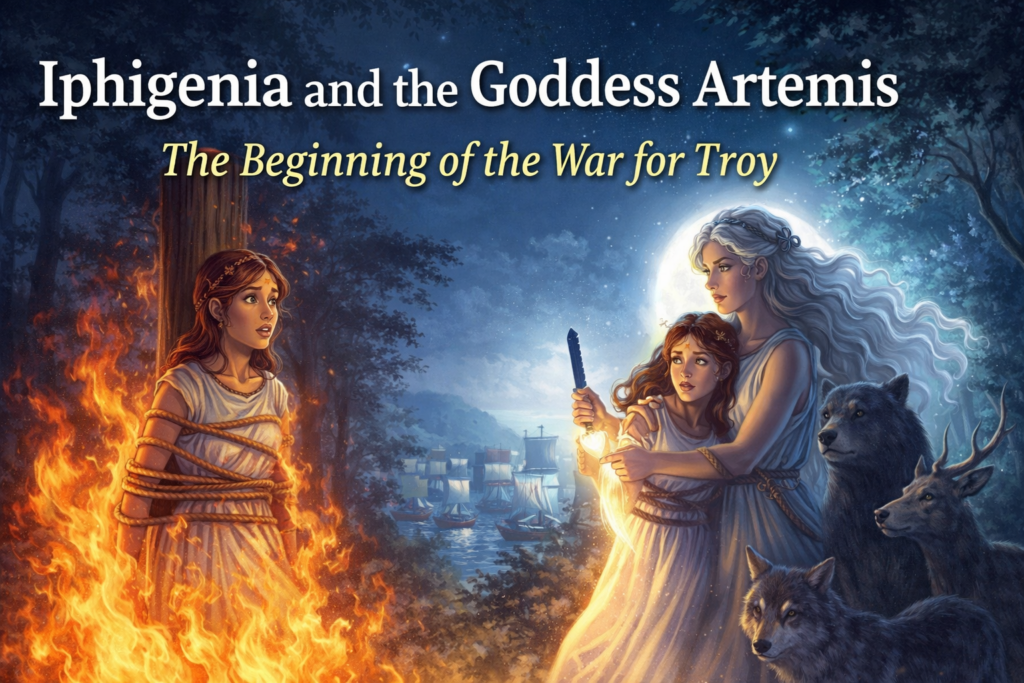
Iphigenia and the Goddess Artemis
The Beginning of the War for Troy
Introduction to Greek Mythology
Greek myths are ancient stories told by the people of Greece. They speak about powerful gods, brave heroes, clever kings, and dangerous monsters.
These stories helped people understand the world, why storms came, why wars happened, and why human choices matter.
The gods in these myths are mighty but often emotional, and the heroes are brave but not perfect. Because of this, Greek myths teach important lessons about courage, patience, wisdom, and responsibility.
What Happened Before This Story
Before this moment, a great trouble had shaken the Greek world. Helen, the beautiful queen of Sparta and wife of King Menelaus, had been taken to Troy by the Trojan prince Paris.
Many years earlier, the kings and warriors of Greece had promised to defend Helen’s marriage if it was ever threatened. So when she was taken away, those kings gathered their armies to sail across the sea and bring her back.
Thousands of warriors came. Hundreds of ships filled the harbours. The Greek kings chose Agamemnon, the powerful king of Mycenae and brother of Menelaus, to lead them all.
But before the war could begin, something unexpected stopped them.
The Great Army at Aulis
The Greek army gathered at a harbour called Aulis, on the coast of Greece. It was an enormous sight.
More than one thousand ships floated in the bay. Their tall masts rose like a forest of wood above the water. Along the shore stretched a vast camp filled with tents, cooking fires, horses, armour, and thousands of soldiers.
It was said that more than one hundred thousand warriors had come to fight.
Everywhere there was noise, men sharpening swords, captains shouting orders, servants running with supplies, and soldiers laughing loudly around fires.
Yet despite all this power, the army could not move.
The wind refused to cooperate.
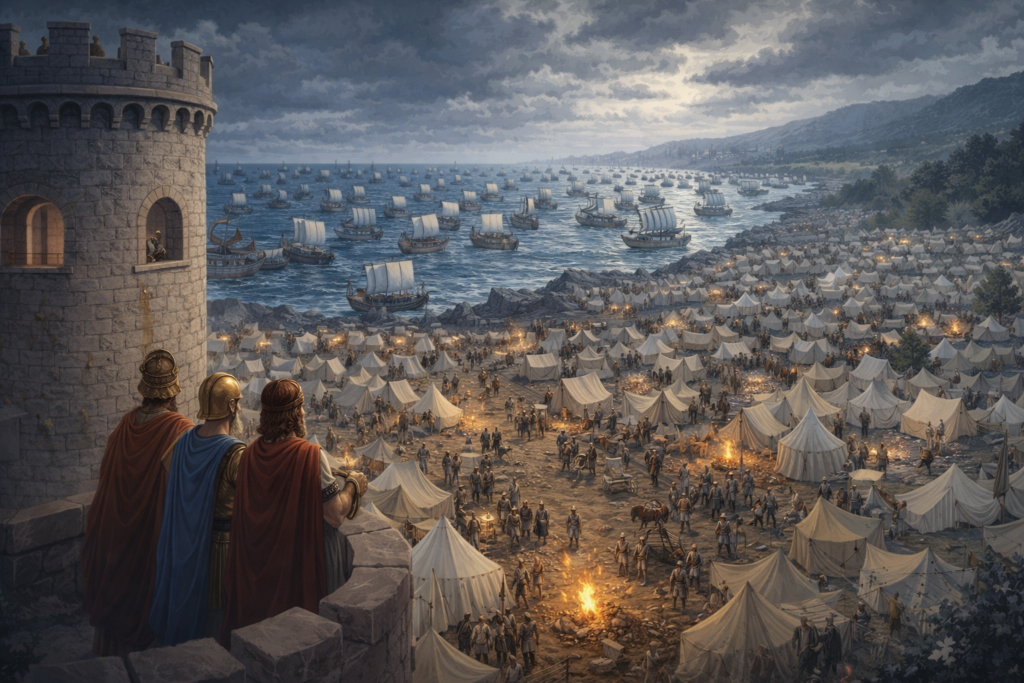
At first, the breeze had guided the ships safely into Aulis. But then it grew stronger and stronger, blowing straight toward the harbour. The waves crashed hard against the ships. The ropes strained and creaked. Captains feared their ships might collide.
No ship could leave.
And without the wind, the Greek army could not sail to Troy.
Sometimes the greatest obstacles in life are not enemies with swords, but problems that patience and wisdom must solve.
The Council of Kings
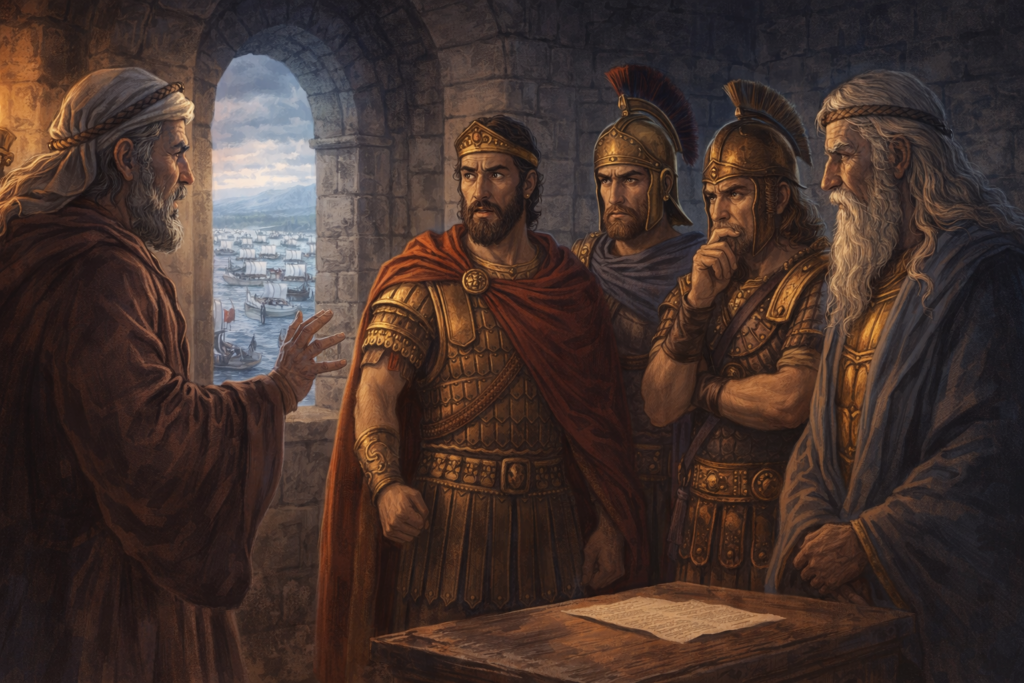
In a tall stone tower overlooking the camp, Agamemnon paced back and forth.
Agamemnon was the most powerful king in Greece, ruler of the rich city of Mycenae. Because of his strength and influence, the other kings had chosen him as commander of the entire army.
But now he looked tired and angry.
With him were his closest advisers.
First was Menelaus, king of Sparta and Agamemnon’s younger brother. It was his wife, Helen, who had been taken to Troy, so he desperately wanted the war to begin.
Next was Nestor, the wise old king of Pylos. Nestor was famous throughout Greece for his wisdom and experience. Many heroes trusted his advice because he had lived long and seen many wars.
Also present was Odysseus, the clever king of Ithaca. Odysseus was known for his sharp mind and brilliant strategies. In many Greek myths, he solves problems that strength alone cannot fix.
Finally, there was Calchas, the army’s seer. A seer was someone believed to understand the messages of the gods, signs in dreams, storms, and the flight of birds.
Agamemnon slammed his fist against the wall.
“We have been stuck here for weeks!” he shouted. “How long can this cursed wind last?”
The other kings exchanged uneasy looks.
At last Nestor spoke calmly.
“We should ask the gods to change the wind.”
Odysseus slowly shook his head.
“The gods are the cause of this wind,” he said thoughtfully. “This cannot be ordinary weather. Some god or goddess is holding us here. We must discover who it is, and why.”
Agamemnon sighed deeply.
“This army cannot sit here forever. Soldiers grow restless. When warriors have no enemy to fight, they begin fighting each other.”
Menelaus nodded grimly.
“And many of these kings did not come only for my sake,” he added. “Some came for glory. Some for gold. If they must wait too long, they may leave.”
An army can be defeated not only by enemies, but also by impatience and doubt.
So the leaders turned to Calchas.
“Find out which god is angry,” Agamemnon ordered. “And tell us what must be done.”
The Hardest Choice
The room fell completely silent.
Agamemnon felt as though the ground beneath him had disappeared.
His daughter?
Iphigenia was young, bright, and kind. He loved her deeply.
For a long moment, he could not speak.
Finally, he stood up and left the room without a word.
The other kings watched him go.
Odysseus spoke quietly.
“It is a cruel thing to ask of any father,” he said. “But if the army cannot sail, all Greece will suffer.”
Leadership often demands choices that test the heart as much as the mind.
That evening, Menelaus and Nestor went to Agamemnon’s chamber.
They found him sitting alone, his head in his hands.
“My king,” Nestor said gently, “the council has decided. The army must sail. Iphigenia must be sacrificed.”
Then Nestor revealed their plan.
A letter had been written to Agamemnon’s wife, Queen Clytemnestra, asking her to bring Iphigenia to Aulis.
The letter said the girl was to be married to Achilles, the greatest warrior among the Greeks.
But the message was a lie.
Once she arrived, they would secretly take the girl away and perform the sacrifice.
Agamemnon stared at the letter.
His hands trembled as he signed it.
A wrong decision does not become right simply because many people agree to it.
Iphigenia Arrives
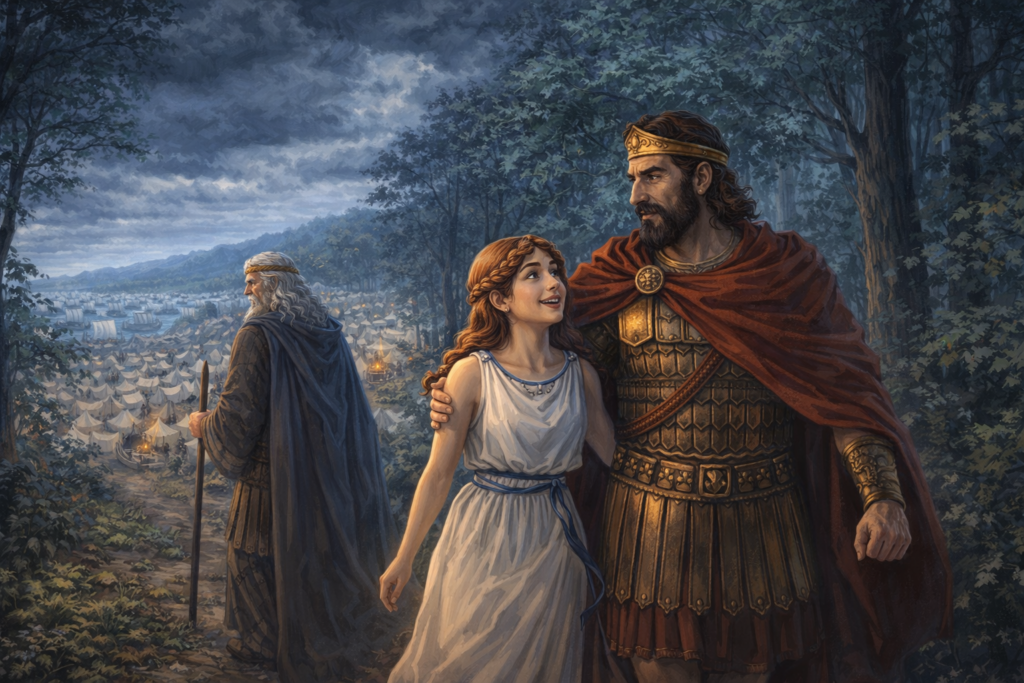
Soon Clytemnestra arrived at Aulis with her daughter.
Iphigenia was excited and happy. She believed she was about to marry Achilles, the most famous hero in Greece.
Odysseus politely showed Clytemnestra around the harbour, distracting her while Agamemnon and Nestor led Iphigenia away.
The girl walked beside her father, smiling brightly.
“Where are we going, Father?” she asked.
Agamemnon forced a smile.
“You will see soon enough, my child.”
But inside, his heart felt as heavy as stone.
Sometimes people hide painful truths behind gentle words because they cannot bear to speak them aloud.
The Forest Clearing
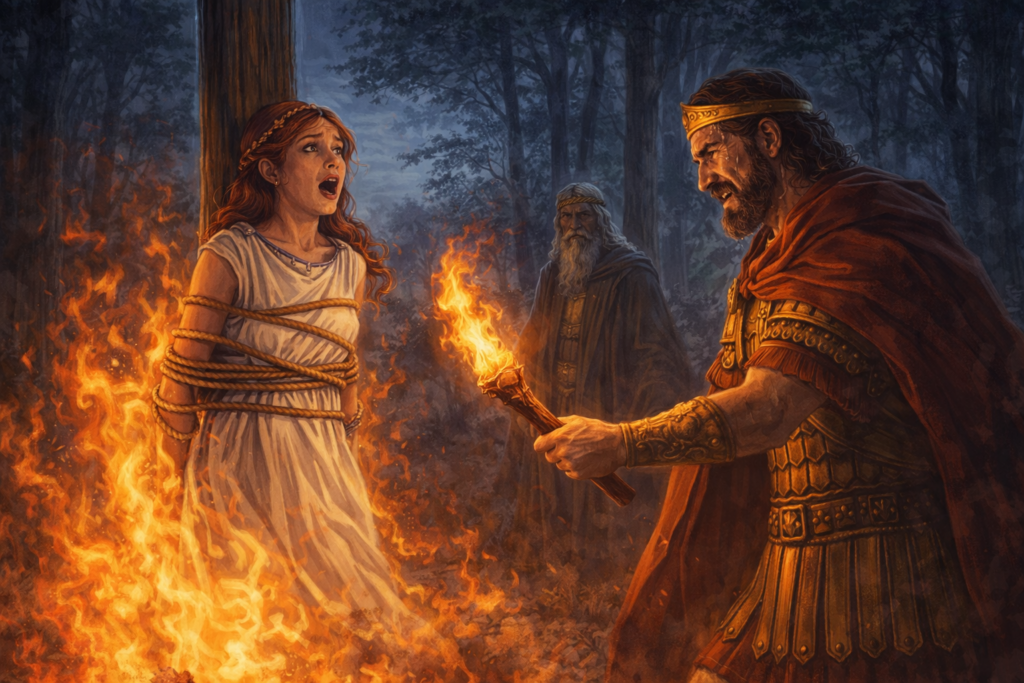
In a forest outside Aulis, Nestor had prepared a great pile of wood.
At its centre stood a tall upright log.
When Iphigenia saw it, her smile faded.
Then soldiers seized her.
They tied her to the wood.
Fear filled her eyes.
“What are you doing, Father?” she cried.
Tears streamed down Agamemnon’s face.
He lifted a burning torch toward the sky.
“Great Artemis,” he cried, “accept this sacrifice! Forgive my mistake!”
Then he set the wood on fire.
Iphigenia screamed.
The Goddess Appears
Suddenly, a voice echoed through the forest.
“I hear you, king of Mycenae.”
Agamemnon looked around in shock.
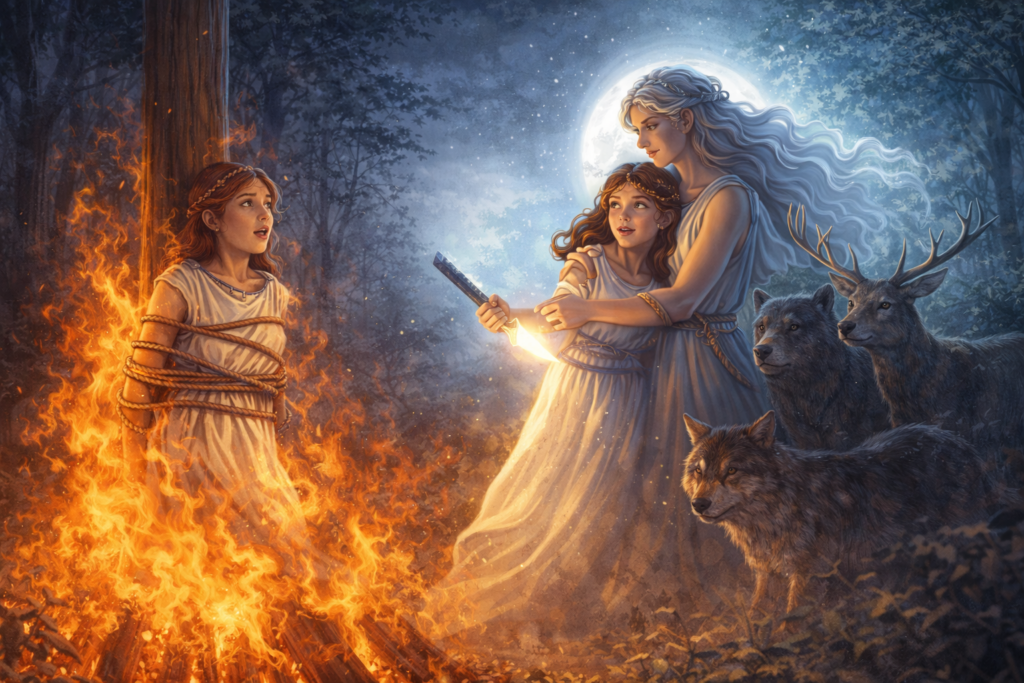
Shadows moved between the trees: wolves, deer, bears, and foxes.
Then a brilliant light shone through the branches.
From that light stepped a woman holding a hunter’s knife.
It was Artemis.
She walked calmly onto the burning wood and cut the ropes that bound Iphigenia.
Lifting the girl gently, she turned to Agamemnon.
“Your daughter is mine now,” she said. “She will serve me forever as one of my hunters.”
Then the light grew brighter than the sun.
When Agamemnon opened his eyes again, Artemis and Iphigenia were gone.
Only the burning wood and the quiet forest remained.
The Wind Changes
Later that night, Agamemnon sat alone on the docks.
The ships rocked in the water. Seagulls cried above him.
Then he noticed something strange.
The wind had changed.
The storm clouds were moving away from Aulis and out to sea.
The fleet could finally sail.
Artemis was satisfied.
The next morning, the harbour was alive with excitement.
Sails were raised.
Men cheered.
Agamemnon stood on the deck of his flagship and shouted:
“We sail for Troy! We will not return without glory and gold!”
The ships began to move.
And so the great Greek fleet sailed toward Troy, toward war, victory, sorrow, and legends that would be remembered for thousands of years.
Every great journey begins with hope, but the choices made along the way determine whether it becomes glory or tragedy.
Pandora’s Box and Other Greek Mythological Stories
New Book Released!
I’m excited to share that I have published a new book on Greek Mythological Stories. This book brings to life the fascinating tales of ancient Greece,filled with gods, heroes, kings, and unforgettable adventures.
If you enjoy stories about Greek mythology, legendary heroes, and epic tales, I warmly invite you to explore this book.
✨ If you would like to read more stories like this, please take a look at my book.
Thank you for your support, and happy reading!