
What the Banyan Tree Whispered
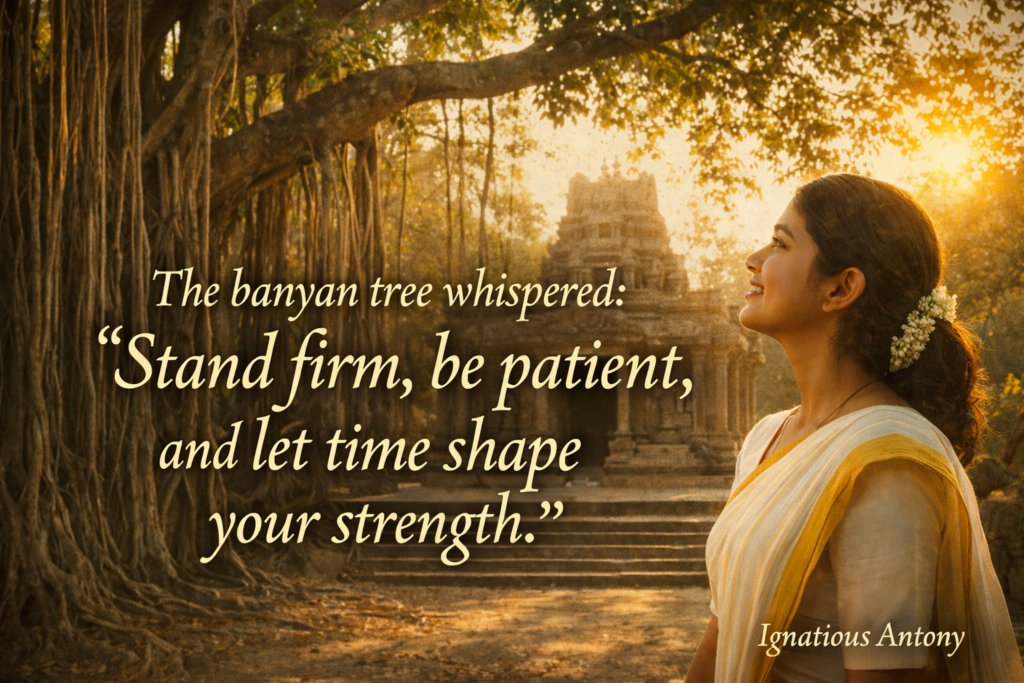
What the Banyan Tree Whispered
Beneath the banyan’s wide and ancient shade,
I paused one day along my wandering way.
Its roots, like silent memories, were laid,
Its leaves spoke softly in the light of day.
It did not hurry, though the winds were strong,
Nor fear the thunder rolling through the sky.
Through rain and sun, it stood its whole life long,
A quiet witness as the years went by.
I asked the tree, “What wisdom do you keep?”
It answered not with words but patient grace.
“Stand firm,” it seemed to say, “though storms may sweep,
Let time and silence shape your rightful place.”
And there I learned what hurried hearts can’t see,
Life’s deepest truths grow slow, like that old tree.
Reflection on “What the Banyan Tree Whispered”
This poem is a quiet meditation on patience, strength, and the slow wisdom that nature teaches to those who pause and listen. The speaker is not rushing through life at this moment.
Instead, he pauses beneath the wide shade of an old banyan tree, a tree that has silently witnessed the passing of many years. In that simple moment of rest, the poet begins to observe the tree not merely as a part of nature, but as a silent teacher.
The banyan tree becomes a powerful symbol of time and endurance. Its roots are likened to “silent memories,” suggesting that the tree has endured countless seasons, storms, and sunshine.
Just like human memory, these roots lie deep beneath the surface, holding the story of many years. The branches and leaves whisper softly, reminding us that nature often communicates in gentle ways rather than loud declarations.
One of the most important ideas in the poem is the contrast between the hurried life of human beings and the calm, patient life of the tree.
People often rush through their days, chasing goals, worrying about the future, and measuring their progress against time.
The banyan tree, however, does not hurry. It stands firmly through wind, rain, and thunder. It does not resist the storm with panic. Instead, it endures it with quiet strength.
The poet asks the tree a question: what wisdom does it hold? The answer does not come in spoken words. Instead, the tree teaches through its presence. Its lesson is simple yet profound—stand firm when storms come, and allow time and silence to shape your life. This wisdom suggests that strength does not always come from struggle or noise. Sometimes true strength lies in patience, in endurance, and in the ability to remain steady while life’s storms pass.
By the end of the poem, the poet comes to understand something many people overlook in their busy lives: the most important truths in life grow slowly. Just as a banyan tree takes decades to spread its roots and branches, wisdom, character, and inner peace also take time to develop. They cannot be rushed.
The poem, therefore, reminds the reader that nature is one of life’s greatest teachers. A quiet moment under a tree can reveal lessons about patience, resilience, and humility. The banyan tree becomes a symbol of how a life well-lived is not one that grows quickly, but one that grows deeply.