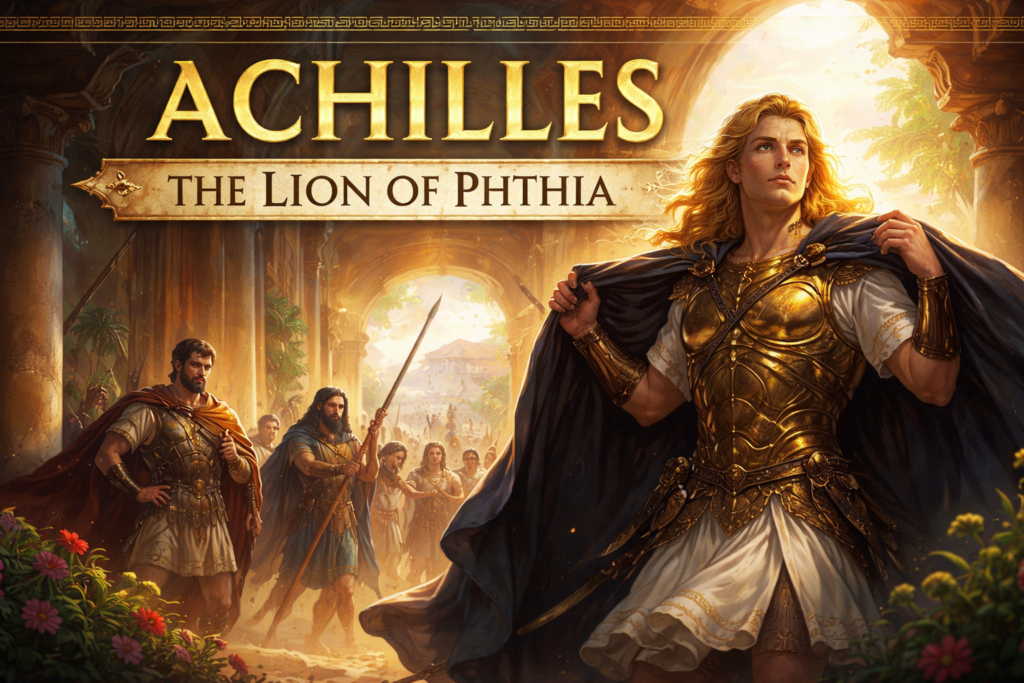
Achilles, the Lion of Phthia
A Short Introduction to Greek Mythology
Greek mythology is a collection of ancient stories told by the people of Greece about gods, heroes, monsters, and brave humans. These stories were told to explain the world, the power of the gods, and the struggles of human life. The heroes in these stories often faced difficult choices, dangers, and great responsibilities. Through their adventures, these myths teach lessons about courage, wisdom, patience, pride, justice, and the consequences of our choices.
What Happened Before This Story
Before this chapter begins, a great wrong had shaken the Greek world. Paris, a prince of Troy, had carried away Helen, the beautiful queen of Sparta and wife of King Menelaus. This insult could not be ignored. Long ago, when many kings and princes competed to marry Helen, they swore a sacred oath to protect the marriage of whichever man she chose. Now that oath had returned like a storm from the past. The Greek kings had to gather their armies and prepare for war against Troy.
Achilles, the Lion of Phthia
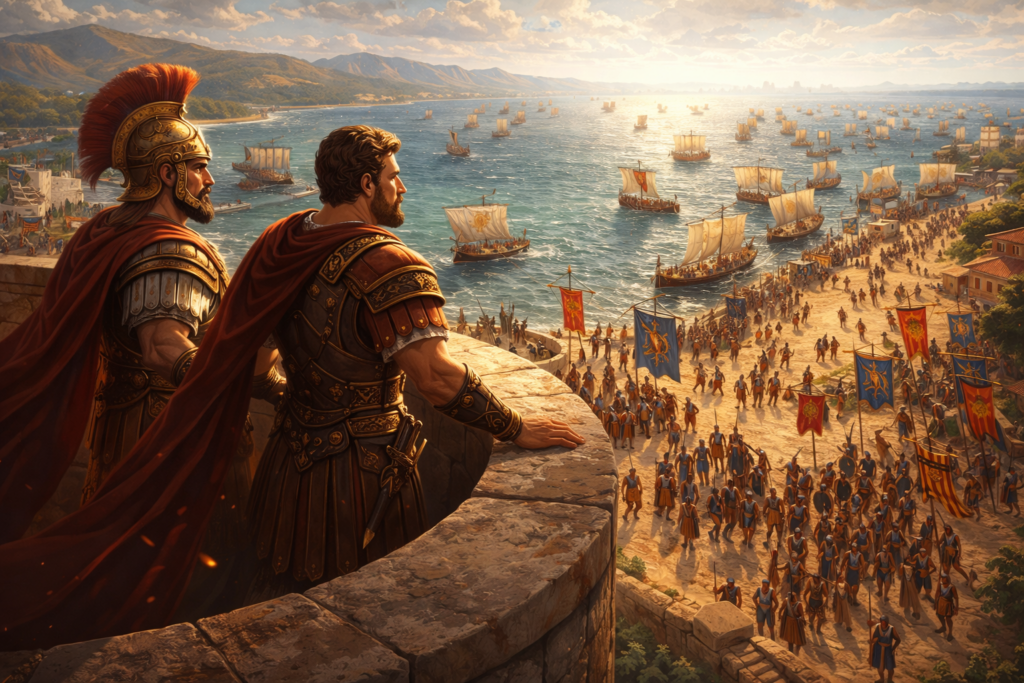
Agamemnon, the powerful king of Mycenae and the leader of the Greek forces, stood on a tall stone tower overlooking the busy harbor of Aulis. Beside him stood his younger brother Menelaus, the king of Sparta and the husband of Helen.
Below them the wide bay was crowded with ships. New vessels arrived every hour. Sailors shouted as they lowered sails. Warriors unloaded shields, spears, and helmets. The sound of hammering, shouting, and marching filled the air. It looked as if the whole of Greece was gathering at that shore.
Agamemnon looked down proudly at the fleet. His heart swelled with confidence.
Menelaus, however, stood with clenched fists. His thoughts were fixed on only one thing.
“Let Paris laugh while he can,” he muttered. “When I reach Troy, he will answer for what he has done.”
Agamemnon smiled slightly.
“More ships are coming every day,” he said. “The oath of the suitors is working. None of them can refuse to come now. Honor demands it.”
And it was true. The great warriors of Greece were arriving one by one.
Ajax came with twelve ships. He was a giant of a man, broad and powerful, carrying a shield as large as a tower. Diomedes arrived with eighty ships, though he was still young. Yet he was already known as a brave and clever commander.
Still, Menelaus looked troubled.
“Troy is not an easy enemy,” he said slowly. “They say the walls of Troy were built by the gods themselves. We will need an army greater than Greece has ever gathered before.”
Agamemnon’s smile widened.
“Yes,” he said. “Troy is strong. Its fields are rich. Its treasures are many. Men will come to our banner for honor, but also for gold and glory.”
A strong wall is not broken only by force. It is broken by patience, wisdom, and the will to endure.
At that moment footsteps echoed on the tower stairs.
Two men climbed up slowly.
The first was Nestor, the wise old king of Pylos. Though his hair was white with age, he was respected by all the Greek kings because of his wisdom and long experience.
The second was Calchas, a priest and seer who could read signs from the gods.
Nestor stopped for a moment to catch his breath. Calchas bowed respectfully before the two kings.
“My lords,” Calchas said quietly, “I bring a message from the gods.”
Agamemnon folded his arms.
“Well? Speak.”
Calchas lifted his eyes.
“Great glory awaits the Greeks at Troy. But only if the lion of Phthia sails with you.”
Agamemnon frowned.
“The lion of Phthia? What kind of riddle is this?”
Nestor cleared his throat.
“The lion of Phthia is not a beast, my lord. It is a man.”
The two brothers looked at him.
“We must send for Achilles,” Nestor said firmly. “The son of Peleus and Thetis. The greatest warrior in Greece.”
Menelaus groaned loudly.
“He is just a boy!”
Agamemnon shook his head.
“And a wild one. He cannot be controlled.”
Nestor’s voice suddenly became sharp.
“And yet he is the finest fighter among all the Greeks. The gods themselves have spoken.”
Fire is young when it first begins, yet it can still burn down a forest.
Agamemnon sighed deeply.
“Very well. If Achilles must be brought, there is only one man clever enough to find him.”
He turned toward the sea.
“Send for Odysseus, king of Ithaca.”
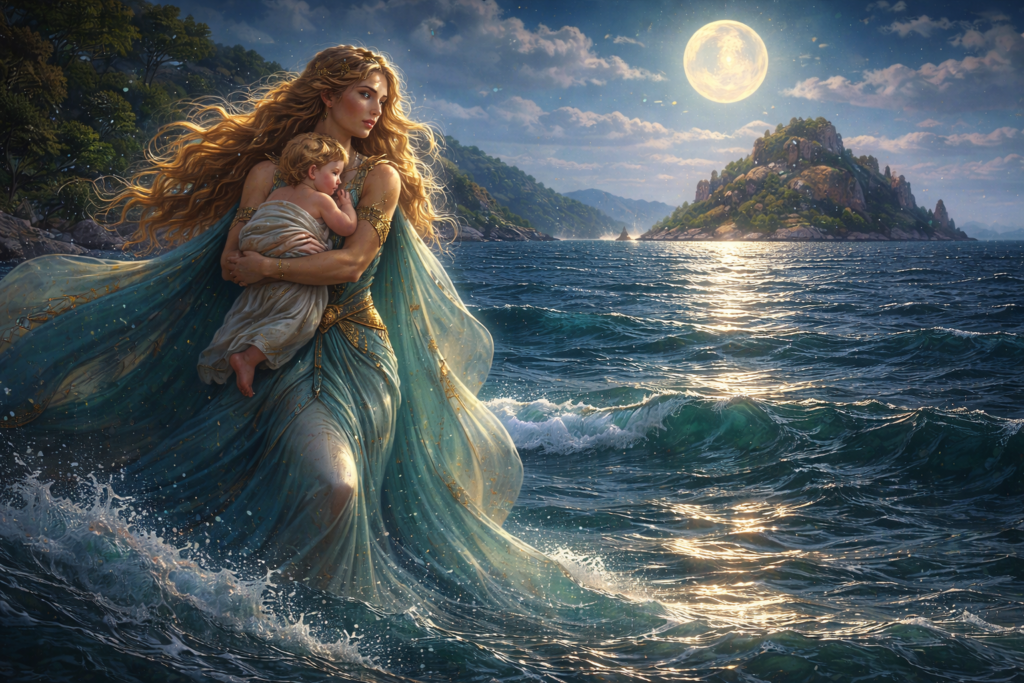
Odysseus was famous throughout Greece, not for great size or strength, but for his intelligence. He was known as the most clever and thoughtful of all the Greek kings.
But on the day the messenger arrived at Ithaca, Odysseus was not thinking about war.
That morning his wife Penelope had given birth to their first child.
The baby boy was named Telemachus.
Odysseus stood on a hill above the sea, holding the tiny child in his arms.
“This kingdom will be yours one day,” he whispered softly.
The baby blinked at the bright sunlight dancing on the water.
Then Odysseus looked out across the sea.
In the distance a ship was approaching the island.
His face changed.
“That ship sails from Mycenae,” he said quietly.
He hurried back to the palace and found Penelope holding the child.
“They are coming for me,” he told her.
Penelope understood immediately.
“If you go,” she said softly, “you may be gone for many years.”
Odysseus nodded slowly.
Wisdom is not always the same as bravery. Sometimes wisdom sees danger long before bravery does.
He thought quickly, and a clever plan formed in his mind.
When the messenger Palamedes arrived at the harbor, Penelope met him with the baby in her arms.
Palamedes was a prince and a clever man, though not as clever as Odysseus.
“I must speak with your husband,” he said firmly.
Penelope lowered her eyes.
“My lord,” she said, “my husband has lost his senses. A strange sickness has filled his mind.”
Palamedes frowned.
“Where is he?”
She pointed silently down the beach.
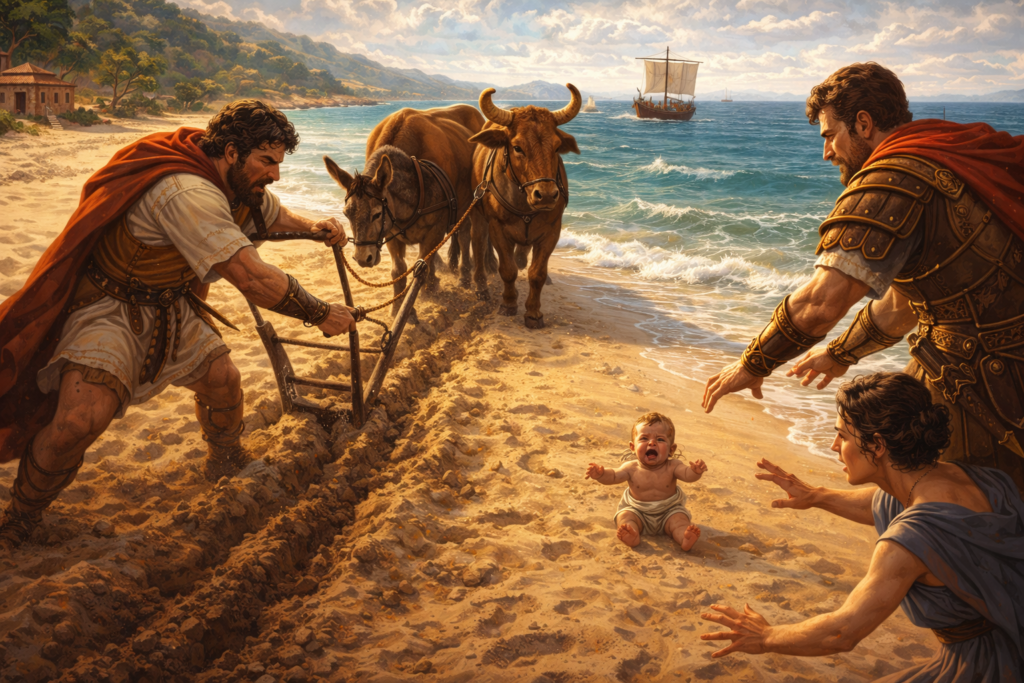
Palamedes walked along the shore and soon saw an astonishing sight.
Odysseus was plowing the sand beside the sea.
He had tied a donkey and an ox together to pull the plow, a foolish pair that could hardly walk together. The waves splashed around his feet as he dragged the plow through the wet sand.
It looked like the work of a madman.
But Palamedes did not believe it.
Suddenly he grabbed the baby Telemachus from Penelope’s arms and laid the child directly in the path of the plow.
Penelope cried out in fear.
Odysseus drove the animals forward.
Then suddenly he shouted and pulled the reins sharply.
The plow stopped just before reaching the baby.
Odysseus rushed forward and lifted his son into his arms.
Tears filled his eyes.
“My boy… my son!”
Palamedes folded his arms and smiled.
“Your trick is uncovered, Odysseus.”
Odysseus looked at him with anger.
Palamedes continued calmly.
“King Agamemnon calls for you and your warriors. We sail first for Phthia, and then for Troy.”
Odysseus looked at his wife, then at the sea.
A promise made long ago can return like a wave and strike the shore of the present.
Finally he nodded.
“I will come.”
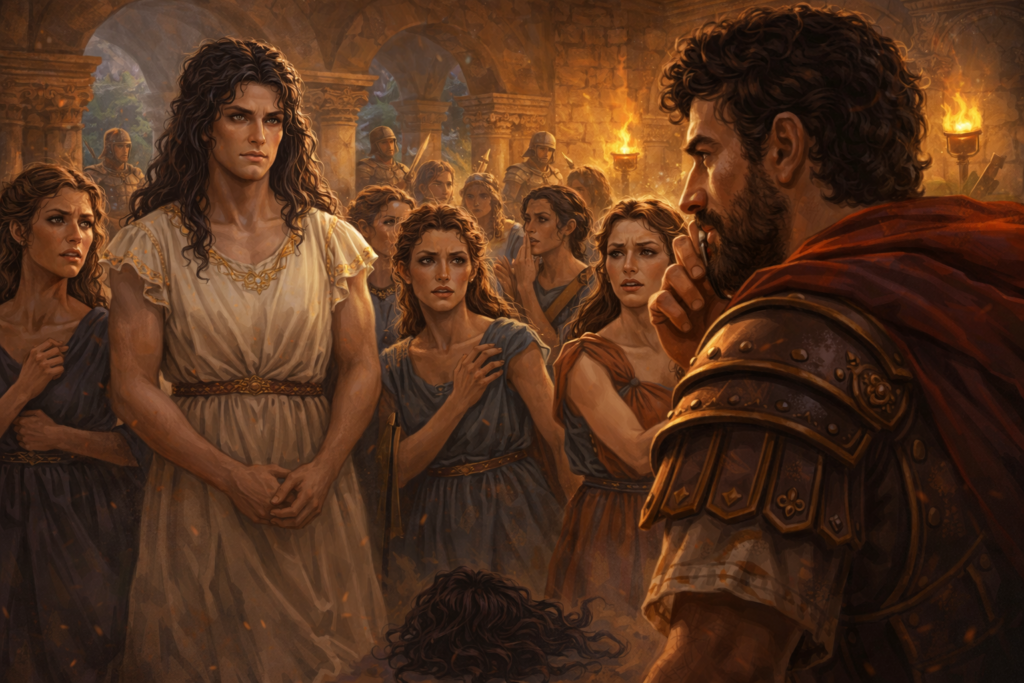
Achilles was the son of King Peleus and the sea-nymph Thetis.
Because his mother was a divine being from the sea, Achilles was born with a destiny greater than most men.
When he was still a baby, Thetis tried to make him invincible.
Some said she dipped him into the dark waters of the River Styx, the sacred river of the Underworld. Others said she anointed him with ambrosia, the food of the gods, and passed him through fire to burn away the mortal part of him.
But before she could finish the ritual, Peleus stopped her. He feared she might harm the child.
Because she held the baby by his heel, that one small place remained vulnerable.
Thus Achilles grew up strong and fearless—but with one hidden weakness.
Thetis loved her son deeply.
But she had also heard a terrible prophecy.
Achilles would have two possible fates.
He could live a long life, forgotten by history.
Or he could die young at Troy, but his name would live forever.
To a mother, such a choice was unbearable.
“I will not let Troy take my son,” she cried.
So one night she secretly took Achilles away from his home in Phthia and brought him to the island kingdom of Skyros.
The king of Skyros, Lycomedes, agreed to hide the boy.
Achilles was disguised as a girl and placed among the king’s servant daughters so that no one would recognize him.
For a time Achilles lived quietly in the palace, wearing soft clothes instead of armor.
Courage is not the absence of fear. Sometimes it is the strength to stand still while fate decides the road ahead.
Meanwhile Odysseus and Palamedes arrived at Phthia.
But they were not fooled by Thetis’ story that Achilles had run away.
Odysseus quietly questioned servants and soldiers.
Soon he discovered that Thetis had taken Achilles away in the night.
“She cannot have gone far,” Odysseus said thoughtfully.
So the two men searched the nearby islands until they reached Skyros.
King Lycomedes welcomed them politely, but he denied knowing anything about Achilles.
Odysseus listened carefully.
Then his sharp eyes scanned the palace courtyard.
Among the servant girls he noticed something strange.
One of them stood taller than the guards.
Her shoulders were strong.
Her movements were alert.
Truth often reveals itself not through words, but through what the body cannot hide.
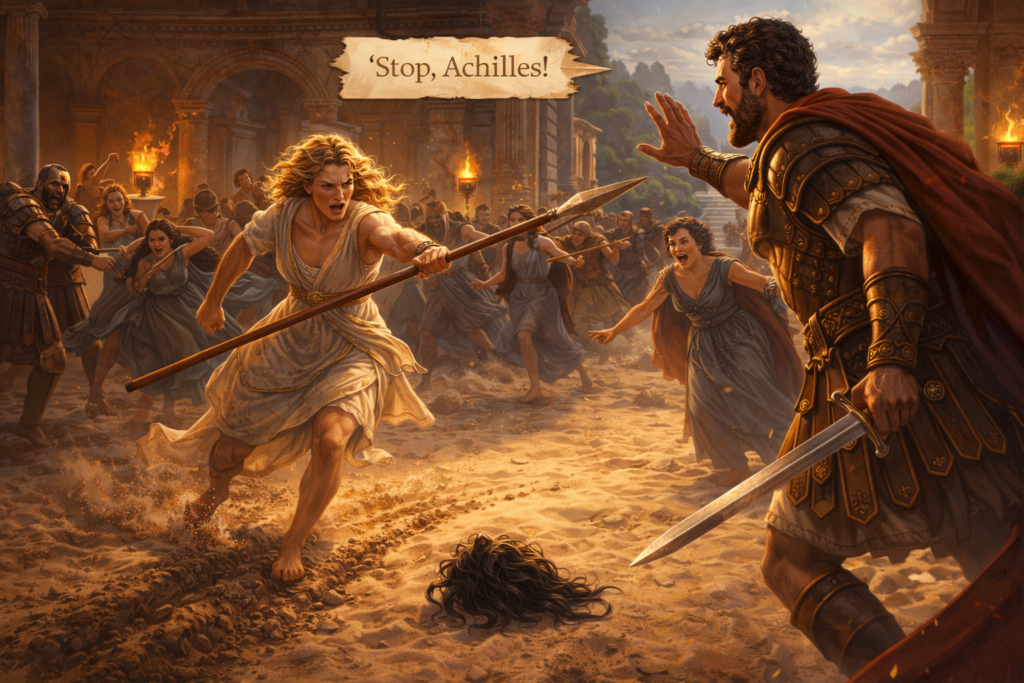
Odysseus quietly nudged Palamedes.
Then suddenly he drew his sword and shouted to his men.
“Seize the servants!”
The courtyard exploded in panic.
The girls screamed and ran in all directions.
But one did not run.
The tall servant girl leaped forward, grabbed a spear from a startled guard, and rushed toward the fight.
In that moment the disguise was broken.
“Stop, Achilles!” Odysseus shouted.
He lowered his sword and raised his empty hands.
“Stop! All of you stop!”
The young warrior froze.
Slowly he reached up and pulled away the dark wig.
Golden curls fell around his shoulders.
Achilles stood revealed.
For a moment he looked surprised.
Then he smiled.
“I told my mother I wanted to go to Troy,” he said.
“I suppose I have no choice now.”
Palamedes stepped forward and laughed.
“That is right. Troy waits for you. Glory, honor, and gold are waiting there.”
Achilles’ eyes shone with excitement.
But Odysseus turned away quietly.
“Yes,” he murmured to himself.
“And how do men gain such things?”
He looked out toward the distant sea.
“By sailing far from home and fighting a war.”
He shook his head slowly.
“I hope it is worth it.”
Not every shining reward is won without sorrow, and not every victory leaves the heart untouched.
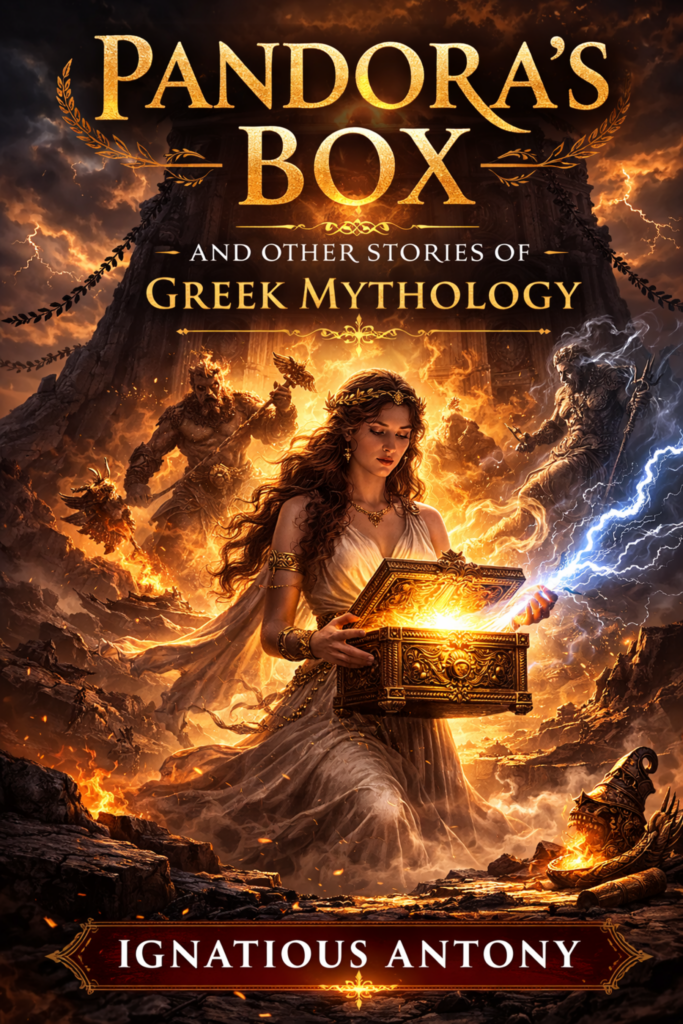
Pandora’s Box and Other Greek Mythological Stories
New Book Released!
I’m excited to share that I have published a new book on Greek Mythological Stories. This book brings to life the fascinating tales of ancient Greece,filled with gods, heroes, kings, and unforgettable adventures.
If you enjoy stories about Greek mythology, legendary heroes, and epic tales, I warmly invite you to explore this book.
✨ If you would like to read more stories like this, please take a look at my book.
Thank you for your support, and happy reading!