
The Primrose That Loved the Sun
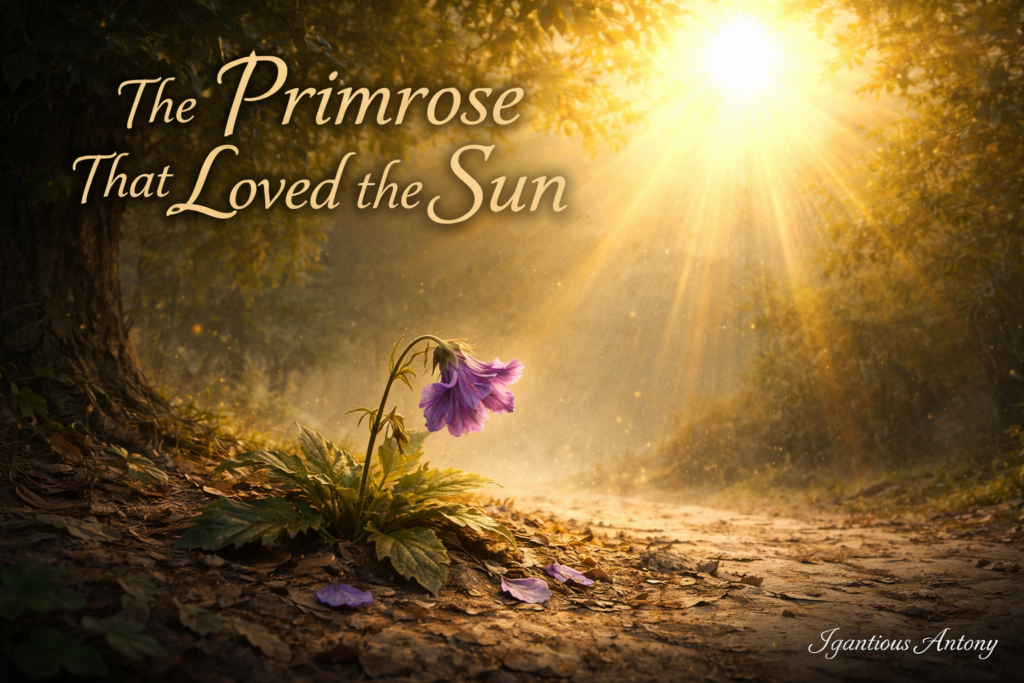
The Primrose That Loved the Sun
I was a small primrose,
a shy violet child of the shade.
My cradle was cool earth,
my roof a quiet cathedral of leaves.
The old tree above me
spread its arms like a patient mother,
and the wind whispered through her branches
like soft prayers in a village chapel.
There in the dim green light
I grew quietly,
petals purple as evening clouds,
breathing the calm air of the forest floor.
Yet deep within my fragile stem
a strange desire began to rise,
like a restless bird beating its wings
inside a tiny rib cage.
I began to dream of the Sun.
The Sun!
That golden king who rode the sky
in a chariot of blazing fire.
I imagined his warm hands
touching my petals.
I imagined shining like a jewel
placed upon a crown of light.
Other plants warned me gently.
“Little primrose,” said the moss,
“the sun is a burning ocean.”
“Stay with us,” whispered the ferns,
“you are a flower of the shade.”
But longing is a stubborn river.
Once it begins to flow,
no stone can stop its journey.
Every morning I stretched my neck upward
like a child standing on tiptoe
trying to see a distant parade.
Through the leaves
I caught only tiny pieces of sunlight,
thin golden threads
stitched into the dark cloth of the forest.
Those threads drove me mad with desire.
I began to fall in love with the Sun
as a lonely poet falls in love
with a star he can never touch.
Days passed.
Months passed.
Then one night the sky grew angry.
The wind roared like a wounded lion.
Thunder rolled across the heavens
like giant drums of war.
The great tree above me trembled.
Its roots groaned in the earth
like old bones breaking.
And then,
with a terrible cry
the mighty tree fell.
Morning came.
For the first time in my life
the Sun stood before me
without a veil.
Golden.
Blazing.
Magnificent.
I rejoiced.
My petals opened wide
like a beggar who had suddenly found treasure.
“Sun!” I whispered.
“At last I am yours.”
But the Sun was not the gentle lover
I had imagined.
His touch was not silk.
It was fire.
By noon
my tender skin began to burn.
By evening
my leaves curled like old paper in a flame.
The next day
my petals shrank
like frightened birds hiding their wings.
The third day
my purple colour faded
like a forgotten painting left in the desert.
No one passing by
could recognise who I had once been.
I had dreamed of becoming a star.
Instead
I had become dust.
The Sun continued his journey across the sky
without ever noticing
the little primrose who had loved him.
And somewhere in the silent soil
my last thought faded
like the final note of a lonely violin.
Not every light is meant for every life.
Some flowers are born for the quiet mercy of shade.
And sometimes the dreams we chase
are the very flames
that consume us.
Reflection on the Poem “The Primrose That Loved the Sun”
This poem is a quiet meditation on longing, identity, and the danger of desiring a life that does not belong to us.
At the beginning of the poem, the primrose lives peacefully in the shade. The environment around it is calm, protective, and nurturing. The tree above acts like a mother, the forest is like a sanctuary, and everything in that world supports the flower’s life. The primrose is not unhappy there. In fact, it is growing beautifully. But within that peaceful life, a subtle restlessness begins to grow.
That restlessness is the heart of the poem.
The primrose begins to admire the sun. The sun appears glorious, powerful, and magnificent. To the flower, the sun represents greatness, visibility, brilliance, and perhaps even glory. The shade suddenly feels ordinary compared to the dazzling brightness of the sun. What was once a safe home begins to feel like a limitation.
This is a very human experience.
Many people look at the lives of others and begin to feel that their own place is too small. A person who is meant for quiet work may begin to desire fame. Someone meant for peace may chase power. Someone who is already flourishing in one environment may start longing for another simply because it looks brighter or more celebrated.
The moss and the ferns in the poem act like wise voices. They warn the primrose that the sun is not meant for it. But longing, as the poem beautifully says, is like a river once it begins to flow. Advice rarely stops desire once the heart has decided.
Then comes the storm , an important turning point. The tree that protected the primrose falls, and suddenly the flower receives exactly what it had been dreaming of. The sun stands before it without any barrier.
For a brief moment, the primrose is joyful. Its dream has come true.
But the reality of the dream is very different from the imagination of the dream.
The sun, which appeared warm and beautiful from a distance, becomes destructive when experienced directly. What the primrose believed would nourish it actually destroys it. Within a few days the flower dries, fades, and disappears.
The most powerful part of the poem is that the sun never notices. The primrose had loved the sun deeply, but the sun was indifferent. It simply continued its journey across the sky.
This adds another layer of meaning. Often, the things we desire most, fame, recognition, power, admiration, do not even notice the individuals who sacrifice everything to reach them.
The closing lines contain the quiet wisdom of the poem:
Not every light is meant for every life.
Some flowers are born for the quiet mercy of shade.
This does not mean that ambition is wrong. Rather, it reminds us that every life has its own nature. Just as some plants need sunlight and others need shade, human beings also flourish in different environments.
The tragedy of the primrose is not that it dreamed. The tragedy is that it failed to recognise the beauty and suitability of the place where it already belonged.
In a deeper philosophical sense, the poem speaks about self-knowledge. The ancient Greeks believed that wisdom begins with one simple idea: “Know thyself.” When we forget who we are, we may chase lights that were never meant for us.
The primrose’s story, therefore, becomes a gentle warning.
Sometimes what shines from a distance may burn us when we reach it.
Sometimes the quiet life we already have is the very place where we can truly bloom.