
Two Self-Made Scientists
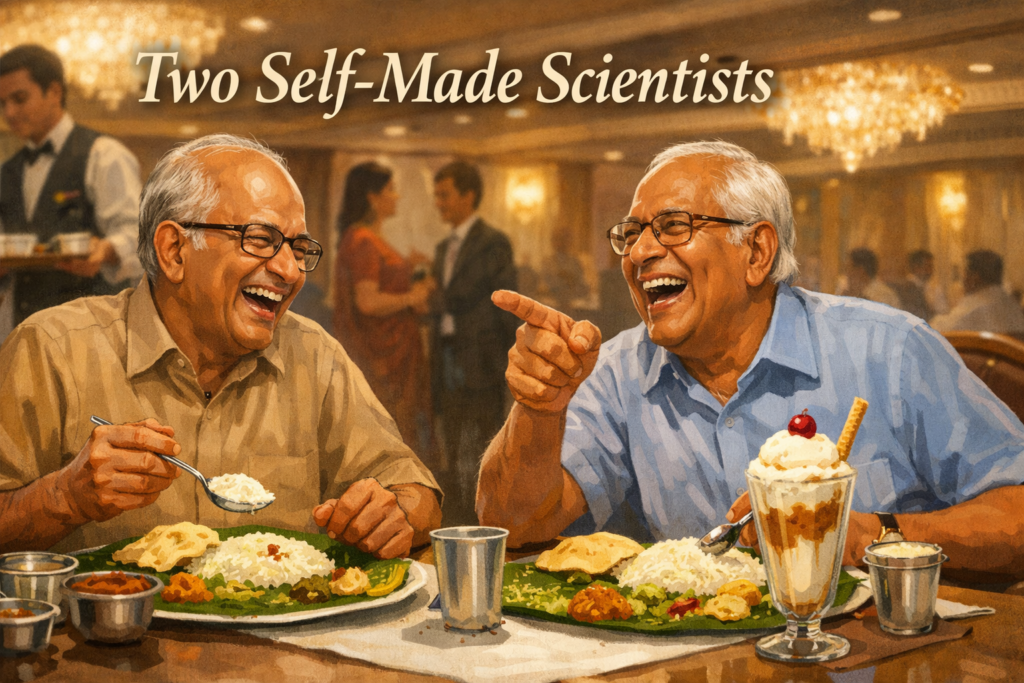
Two Self-Made Scientists
The ballroom of the Sheraton in Bangalore glowed with soft light. Crystal chandeliers hung quietly above polished floors, and the evening air carried the steady murmur of technical conversations.
It was the IEEE chapter’s annual conference. Posters on advanced electronics and space technologies lined the walls. Young engineers moved briskly between sessions with notebooks and laptops, while senior professors spoke in thoughtful clusters.
Near a long table of coffee urns and neatly arranged pastries stood two elderly men, each reading the other’s name badge with mild curiosity.
For a moment, they looked uncertain.
Then one of them smiled.
“Narayanan?”
“Joseph! Is that really you?”
They shook hands warmly.
KPS Narayanan and K. Joseph Mathew had retired from the Indian space programme nearly twelve years earlier. For decades, they had worked in different sections of the launch vehicle programme at the Vikram Sarabhai Space Centre in Thiruvananthapuram.
Time had slowed their walk, but not their memories.
They moved to a quiet corner beside a glass wall overlooking Bangalore’s lights.
For a few minutes, they spoke about health, children, and grandchildren,the small polite currency of old age.
Then Joseph took a sip of the conference coffee and said thoughtfully,
“This is excellent coffee.”
Narayanan smiled.
“Yes. Perhaps too excellent. It would never have survived in our old canteen.”
Joseph laughed.
“Ah, yes… the canteen coffee! Half coffee, half philosophy.”
Narayanan leaned back in his chair.
“You know,” he said, glancing toward the young engineers moving around the hall, “listening to them today, one might think great programmes are built mainly with presentations and strategic frameworks.”
Joseph nodded.
“History often polishes achievements so well that the rough struggle beneath them becomes invisible.”
“Exactly,” he said. “Today, people see only the final photograph, the rocket rising into the sky, the satellite entering orbit, leaders smiling.”
“But they do not see the years behind that moment,” Narayanan said quietly.
Joseph stirred his coffee.
“When I joined the programme,” he said, “my salary was so small that by the third week of every month my financial planning depended heavily on the canteen menu.”
Narayanan smiled.
Joseph sat up with mild protest.
“You speak of modest salary as if it were a personal invention of yours. My dear man, my first paycheck barely covered rent, bus fare, and milk for the children. Ordering one extra dosa in a restaurant required serious financial planning.”
Narayanan chuckled.
“In my case, it required committee approval.”
Joseph laughed.
“And we were supposed to be designing launch vehicles.”
Narayanan nodded thoughtfully.
“Our friends in other government departments were enjoying quite different lives, staff cars, air-conditioned offices, orderly file movement, peons who carried papers respectfully.”
Joseph counted on his fingers.
“We had one fan, poor facilities, and a laboratory instrument treated with more respect than a temple idol.”
“And the stores department,” Narayanan added.
“Ah, yes,” Joseph said. “The great philosophical department.”
“When we urgently needed one connector,” Narayanan said, “they would say ‘Indent already raised.’”
“And after one week?”
“‘File under process.’”
“And after a month?”
“‘Specification requires revision.’”
They both laughed.
“In great institutions, delay often learns to speak the language of procedure.”
After a moment, Joseph asked softly,
“Do you remember the SLV days?”
Narayanan’s expression changed.
“Yes,” he said quietly.
For a few seconds, neither spoke. Some memories arrive slowly, like distant weather.
“We were young,” Joseph said finally.
“Too young to understand how difficult it really was.”
Narayanan nodded.
“Or perhaps we understood… but had no time to worry.”
Joseph leaned forward.
“Those were long days. And longer nights.”
Integration problems. Power supply issues. Telemetry glitches. Structural adjustments. Endless reviews. Endless calculations.
“And very few facilities,” Narayanan said.
Joseph smiled.
“One engineer in our section kept a towel, toothbrush, and spare shirt in the lab cupboard.”
“That was his mission support kit,” Narayanan said.
They both smiled.
Joseph continued quietly,
“You know, whenever people speak about SLV today, I remember one particular story.”
Narayanan nodded.
“The story Dr. Kalam himself used to tell.”
Joseph’s face brightened.
“Yes. That one.”
He set his cup down and spoke slowly.
“You remember the first SLV-3 launch in 1979.”
Narayanan nodded.
“Yes. The vehicle did not reach orbit.”
“It was a painful moment,” Joseph said.
The young programme director then was Dr. A. P. J. Abdul Kalam. The chairman of ISRO was Professor Satish Dhawan.
Joseph continued.
“After the launch failure, the press conference had to be held. The whole country was waiting for an explanation.”
Narayanan nodded.
Joseph smiled softly.
“And do you know what Satish Dhawan did?”
“He faced the press himself,” Narayanan said.
“Yes,” Joseph replied. “He told Kalam: ‘You go and take rest.’”
Joseph paused.
“The chairman stood before the press and took full responsibility for the failure.”
Narayanan nodded slowly.
“That was leadership.”
Joseph continued.
“And then the next year… when SLV-3 succeeded.”
Narayanan smiled.
“Yes.”
“Professor Dhawan asked Kalam to face the press conference,” Joseph said.
“And Kalam gave credit to the entire team.”
“Yes.”
Joseph leaned back.
“That moment taught many of us something we never forgot.”
Narayanan said quietly,
“A true leader accepts responsibility for failure and gives credit for success to the team.”
Joseph nodded.
“That was the culture that allowed the programme to grow.”
They sat silently for a moment.
Then Joseph smiled again.
“But let us not pretend everything was noble.”
Narayanan raised an eyebrow.
Joseph lowered his voice.
“There were also rumours.”
Narayanan laughed.
“Of course.”
“One rumour about promotions.”
“One rumour about transfers.”
“One rumour about who was close to which senior.”
“One rumour about who would become the next project director.”
Narayanan nodded.
“And quite often the rumour about promotions came true.”
Joseph smiled knowingly.
“A promotion may appear on paper in a day; the disappointment it leaves behind may remain for years.”
Joseph stirred his coffee again.
“You know, some of the most capable people we had were not always the ones who rose highest.”
Narayanan nodded.
“That is true.”
Joseph continued thoughtfully.
“I remember some brilliant women scientists in those years. Exceptionally sharp minds. They could walk into a review meeting and quietly detect a flaw everyone else had missed.”
Narayanan said softly,
“Yes… There were a few like that.”
“They were respected professionally,” Joseph said.
“But often sidelined quietly.”
Narayanan nodded.
“They were praised… and then someone else was asked to coordinate.”
Joseph laughed gently.
“And the coordinator would spend six months creating confusion.”
Narayanan smiled.
“While the person who understood the system sat quietly in the second row.”
Both men became thoughtful.
“Talent does not shrink when ignored; it only becomes lonelier.”
After a moment, Joseph said,
“Still, we must admit there were good leaders.”
“Yes,” Narayanan said. “Some chiefs protected their teams. Some seniors encouraged young engineers.”
“And the friendships,” Joseph added.
Narayanan smiled warmly.
“Yes… the friendships.”
Shared bus rides. Shared tea. Shared frustrations. Shared small victories.
And humour.
Without humour, none of it would have been survivable.
“Humour is often the small umbrella under which tired people protect their spirit.”
After a while, Narayanan said mischievously,
“Still, your struggles were nothing compared to ours in avionics.”
Joseph sat up.
“Oh, really?”
“Yes,” Narayanan said solemnly. “We had responsibility without glamour.”
Joseph replied instantly.
“Launch vehicle work meant pressure without sleep.”
“I spent three nights in the lab.”
“We spent five.”
“We slept on tables.”
“We slept under tables.”
Soon they were laughing again like two young engineers competing over old war stories.
A steward approached.
“Gentlemen, lunch is being served. Indian or continental?”
Joseph said with dignity,
“For me, something very simple. Perhaps plain curd rice.”
The steward turned to Narayanan.
“The same for me,” he said.
The steward waited politely.
Joseph and Narayanan looked at each other.
Then Narayanan cleared his throat.
“Actually… perhaps the full South Indian lunch.”
Joseph added immediately,
“And one scoop of ice cream.”
When the steward left, Joseph said quietly,
“Whatever we say… conference food is better than our old canteen meals.”
Narayanan nodded honestly.
“Much better.”
They ate slowly.
The hall around them buzzed with presentations on future technologies and upcoming missions.
After a while, Joseph said softly,
“Despite everything… we were fortunate.”
Narayanan looked at him.
“Yes,” he said.
“We did not have high salaries.”
“No.”
“Nor smooth careers.”
“Certainly not.”
“But we had work that mattered.”
Narayanan nodded slowly.
“Yes.”
“Not every difficult life becomes meaningful.
But a difficult life spent building something larger than oneself leaves a rare kind of peace.”
They finished lunch and stood up.
At the doorway, Joseph said,
“You must come again next year.”
Narayanan replied,
“Only if the coffee improves.”
They shook hands and walked back into the conference hall, two quiet veterans carrying inside them the noise of test benches, the tension of countdown clocks, the laughter of canteens, the wounds of forgotten promotions, and the deep pride of having helped build something that would outlive them.
“The world remembers the launch.
Only the workers remember the sleepless nights before it.”