
Once, in the Golden Days of Onam…
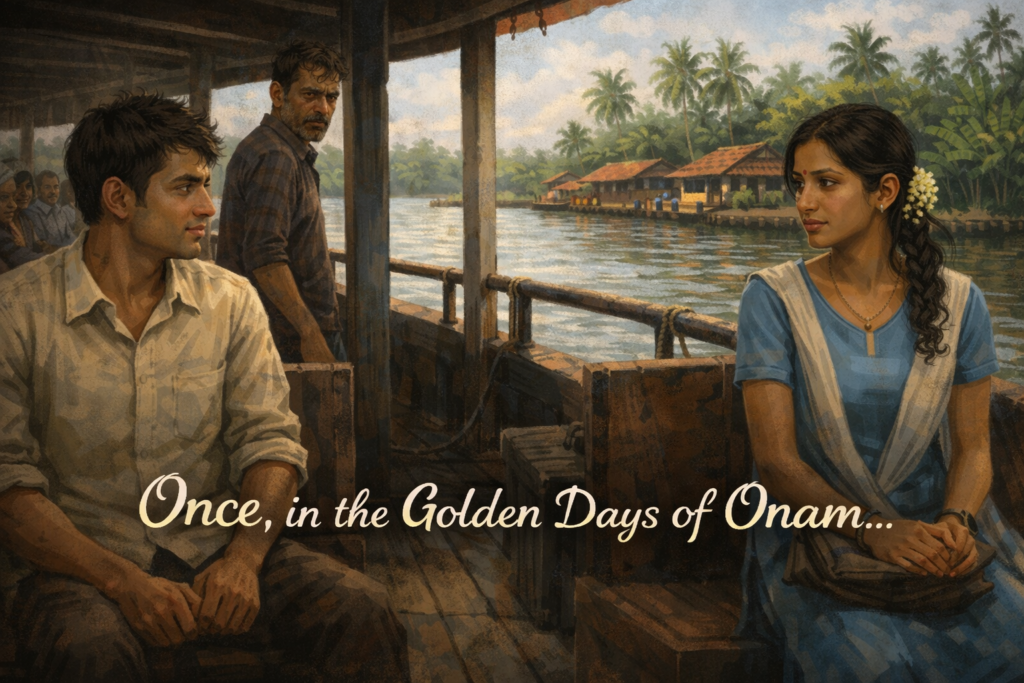
Once, in the Golden Days of Onam…
Onam arrives in Chingam (August–September), but no Malayali needs a calendar to confirm it. The land itself sends notifications.
One morning, the rain politely steps aside, as if even the monsoon understands festival etiquette. The sunlight turns soft and golden, no longer the angry, unforgiving glare that makes you question your life choices. It spreads gently across red-tiled roofs like a blessing from a well-meaning elder.
Coconut trees stand freshly bathed and slightly proud of themselves. Banana plants stretch their wide leaves like overenthusiastic hosts welcoming King Mahabali personally. Hibiscus flowers bloom in dramatic red. Modest white thumbapoo peek from the grass as though pretending innocence in a grand floral conspiracy.
Bougainvillaea tumble over compound walls in reckless pinks and oranges, as if someone celebrated too early with coloured powder. Courtyards begin displaying pookkalams so symmetrical that they could cause family disputes.
The air smells of wet earth slowly drying, tender banana leaves waiting for sadya, jasmine woven into thick braids, and somewhere far away, the unmistakable promise of ghee warming in a kitchen.
It feels as though the entire state has dressed up to receive Mahabali once again and is slightly anxious about whether he will notice the effort.
During Onam, even the wind seems to carry a sense of nostalgia.
That kind of morning makes the heart restless without permission.
You feel you should not sit inside.
You feel you should go somewhere.
Anywhere.
Even if you don’t know where.
Sometimes the body remains at home, but the mind has already left through the window.
That day I woke to a sky so blue it looked freshly painted. From the neighbouring house, an old Yesudas song floated out, slightly off-tune but deeply committed.
Downstairs, our neighbour auntie shouted,
“Moneee! Milkman came! Don’t pretend you didn’t hear!”
From another house:
“Ammaaa! School venda! Onam alle! Today holiday aakkanam!”
Even the crows sounded festive.
I combed my hair with unnecessary speed, swallowed a banana like a man on a mission, and announced,
“Amma, I’m going out.”
She narrowed her eyes. “Where?”
I hesitated. “Just… outside.”
“Outside where?”
“Just… walking.”
She laughed knowingly. “Onaghosham, alle? Don’t come back late.”
There is something dangerous about a mother who understands too much.
How I Reached the Backwaters Without Planning To
I walked aimlessly. People I passed looked relaxed, almost forgiving. Even auto drivers were smiling, a rare meteorological event.
Near the tea shop, one uncle declared,
“Chetta, today the sun is like a golden dosa. Perfectly roasted. Not too hot.”
Another replied,
“Yes, yes. Today is a day to fall in love.”
Everyone laughed, including me.
Without knowing how, I reached the backwaters near the ferry point. Small boats moved like lazy thoughts. Bigger tourist boats floated heavily, like retired elephants refusing to hurry.
One boat was about to leave. Families climbed in. College students posed for photos. An elderly couple carried a bag of guavas as if transporting treasure. Two office men, clearly escaping work, pretended they had “field duty.”
I bought a ticket without thinking.
The ticket man tore it and said, “Quick. Boat won’t wait for your destiny.”
I sat on the side bench.
The water shimmered brown-green, holding secrets and maybe lost slippers. The breeze touched my face softly.
And that strange Onam feeling returned, the feeling that something important was about to happen, though you have absolutely no idea what.
The Girl Next to Me
Then I noticed my neighbour in the boat.
A girl, maybe around my age or a little older, like 17 or 18.
She wore a simple light-blue churidar and a small black bindi. Her hair was tied back, but loose strands danced in the breeze. She held a small cloth bag, maybe a lunch box, maybe sewing items, maybe something important.
She looked like someone who works hard.
Not like a rich person.
Not like a tourist.
Just… real.
I tried not to stare.
But my eyes kept coming back.
Because in the time of Onam, everything looks extra beautiful.
Even ordinary things look like poetry.
Her hair smelled faintly like soap and coconut oil.
She looked out at the water, and her lips almost smiled, like she was remembering something happy.
She turned slightly and noticed me looking.
I quickly looked away.
My heart started beating fast for no reason.
After a minute, she glanced again.
This time, she smiled, small, quick, like a secret message.
And in that one smile, my brain started creating a whole movie.
I imagined her name.
I imagined her voice.
I imagined walking with her under coconut trees.
I imagined too much.
The Onam season is dangerous because it makes the heart believe every dream is possible.
I was about to say, “Hi,” or “Where are you going?” or even something stupid like “Nice weather, alle?”
But before I could open my mouth,
Someone tapped my shoulder.
A Strange Man With Sad Eyes
I turned.
A man stood there.
He was not young and not old, maybe in his late 30s or early 40s. He wore a simple checked shirt and had tired eyes like someone who sleeps with worries.
He looked at me the way a teacher looks at a student who is about to do something foolish.
“I want to talk to you,” he said.
I made a face, because… come on… who talks like that on a boat?
He quickly added, “It’s important.”
I sighed.
“Okay,” I said, and followed him to the front side of the boat, where the engine sound was louder, and fewer people were listening.
He leaned closer and said in a serious voice:
“Monu… in the rainy season, people warn you, ‘Don’t catch fever. Don’t get wet. Wear slippers. Drink kashayam.’ Right?”
I blinked. “Yes…?”
“And in summer, people warn you, ‘Drink water. Don’t go out at noon. Don’t get sunstroke.’”
I nodded slowly. “Okay…”
He lifted one finger like he was giving a lecture.
“But in The Onam season … nobody warns you about the most dangerous thing.”
I frowned. “What?”
He looked at me straight and said:
“Love.”
I almost laughed. “What?”
He continued, like he was reading a warning board:
“Onam comes. The breeze becomes sweet. The trees become green. Girls smile more. Boys become stupid. And love waits like a trap near every corner, tea shop, bus stop, tuition class, even this boat!”
He pointed subtly toward the bench where the girl sat.
“Beware, son. Beware of love.”
I felt my face become hot.
“Chetta, what is your problem?” I asked, trying to sound brave.
He sighed. “I’m not interfering for fun. Listen to my story. Then you will understand why I spoke.”
Something about his tired voice made me stay.
“Say,” I muttered.
His Story: “I Also Became a Fool”
He leaned against the railing, watching the water.
“This happened 14 – 15 years ago, around this same season,” he began.
“I work in a government office in Alappuzha. Typical office. Files, stamps, tea break, bosses shouting like they own the air.”
I smiled a little. That sounded familiar.
“One day, the sky was bright like today. Even the pigeons were happy. I felt like running away from that office.”
He laughed bitterly.
“So I told my boss, ‘Sir, I’m not feeling well.’”
“What did the boss say?” I asked.
He copied the boss’s voice perfectly:
“‘Not feeling well? Then resign! You people want to leave for everything!
I giggled.
“He still gave leave,” the man said. “I escaped and came to this backwater boat ride. Same type of day. Same sweet breeze.”
He paused.
“And then… I saw a girl.”
I looked back toward my bench automatically.
The man followed my eyes and shook his head.
“Yes, like that only.”
He continued.
“She came and sat opposite me. Simple dress. Small smile. A parcel in her hand. She looked extra pretty in the sunlight. That’s the problem. Onam adds a beauty filter in a phone camera.”
I tried not to laugh.
He went on.
“We kept looking. She looked away. I looked again. She smiled. I smiled. Slowly, it felt like we knew each other for years.”
He held his head like he was getting a headache from memory.
“I spoke to her. She spoke back. Her voice was sweet. I thought, ‘This is fate!’”
He breathed in slowly.
“She got off at a stop near a small temple. I followed like a goat following fresh grass. She delivered her parcel somewhere and came back, but the boat had already left.”
“So what happened?” I asked, now curious.
“We started walking,” he said. “Just walking. The breeze was warm. Birds were shouting. Even the river looked romantic.”
He shook his head again.
“I asked her, ‘Shall we walk through the coconut grove side?’ She looked me up and down, checking if I was dangerous or safe.”
“And?” I asked.
“And she said yes.”
His voice became softer.
“We walked under trees. She laughed. She ran. I also ran. Imagine me, a grown man, running like a school boy.”
He smiled for the first time, then immediately looked sad again.
“She sang too.”
“What song?” I asked.
He made a disgusted face.
“Some film song. The same song again and again. At that time, it felt like music from heaven. Later… that I don’t want to tell you.”
I laughed loudly. “Chetta, you’re funny.”
He didn’t laugh.
“Then she got tired and sat on the grass,” he said. “I sat near her. I held her hands.”
He looked at his own hands as if he could still feel them.
“Her fingers had tiny marks, like she does sewing work, or packing work. I thought, ‘Ah… hardworking girl… pure heart.’”
Then he spoke in a sharper voice:
“But listen, Monu. People say those marks are ‘sacred.’ They think it means innocence.”
He looked at me seriously.
“It doesn’t always mean that. It means struggle, yes. But it also means exposure to gossip, rough life, people taking advantage, and a world that teaches clever tricks for survival.”
I swallowed.
He continued.
“I looked into her eyes. Deep eyes. And I believed it was ‘soul connection.’”
He gave a dry laugh.
“Big lie. If we could really see someone’s soul fully, we would be scared, and we would run.”
We don’t fall in love with reality. We fall in love with the story we create in our heads.
He sighed.
“I became emotional. I started saying love dialogues. She listened like she was watching TV.”
I asked softly, “Then?”
“Then I started meeting her every Sunday. I took her to beaches, parks, small temples, and food spots. And she acted as if she loved me.”
His jaw tightened.
“Three months later, I married her.”
My eyes widened. “Married?! So fast?”
He nodded slowly.
“Because I was lonely. No family nearby. No one to slap me and say ‘Stop, fool.’ So I thought, ‘A wife will make life sweet.’”
His voice turned heavy.
“And after marriage…”
He looked away.
“From morning to night, she shouted. She called me useless. She fought with shopkeepers. She told our private matters to neighbours. She sang that same song loudly while cleaning.”
He closed his eyes like he was remembering pain.
“And my house became noisy, dirty, and full of drama.”
He looked at me with tired sadness.
“Now every day, I feel like crying. I am stuck. And it all started… Once, in the Golden Days of Onam…
… on a boat… with a smile.”
He placed his hand on my shoulder.
“So I’m warning you, my son. Don’t become me.”
The Boat Stops, And the Trap Smiles
At that moment, the boat slowed down near a landing.
The girl next to my seat stood up to get out.
She walked past us.
As she passed me, she gave a sideways glance and a small smile, exactly like a hidden arrow.
My heart jumped.
My feet almost moved.
I was about to follow her without thinking.
But the man suddenly grabbed my arm.
“Don’t go,” he whispered sharply.
I pulled my arm back. “Chetta, leave me!”
He grabbed my shirt sleeve.
“Monu, please.”
Then I tried to walk fast.
And he, in panic, held the back of my shirt and shouted loudly:
“You shall not go! You shall not go!”
People turned.
People stared.
Two college boys burst out laughing.
One aunty whispered, “Ayyo, what a scene!”
I froze.
My face burned with shame.
The boat started moving again.
On the shore, the girl looked at me for two seconds, a disappointed look on her face… then turned and walked away.
The man released my shirt slowly.
He rubbed his palms as if he had saved a life.
Then he leaned closer and whispered with a proud sigh:
“You must accept… I did you a big service.”
I stood there, furious… but also confused.
Because deep inside, I wasn’t sure whether he saved me,
or stole something from me.
I looked at the water.
The sunlight danced on it.
And somewhere in my chest, a quiet ache began.
Perhaps the greatest heartbreak is not losing love… but losing the chance to find out what it might have been.