
Thankamma Chechi
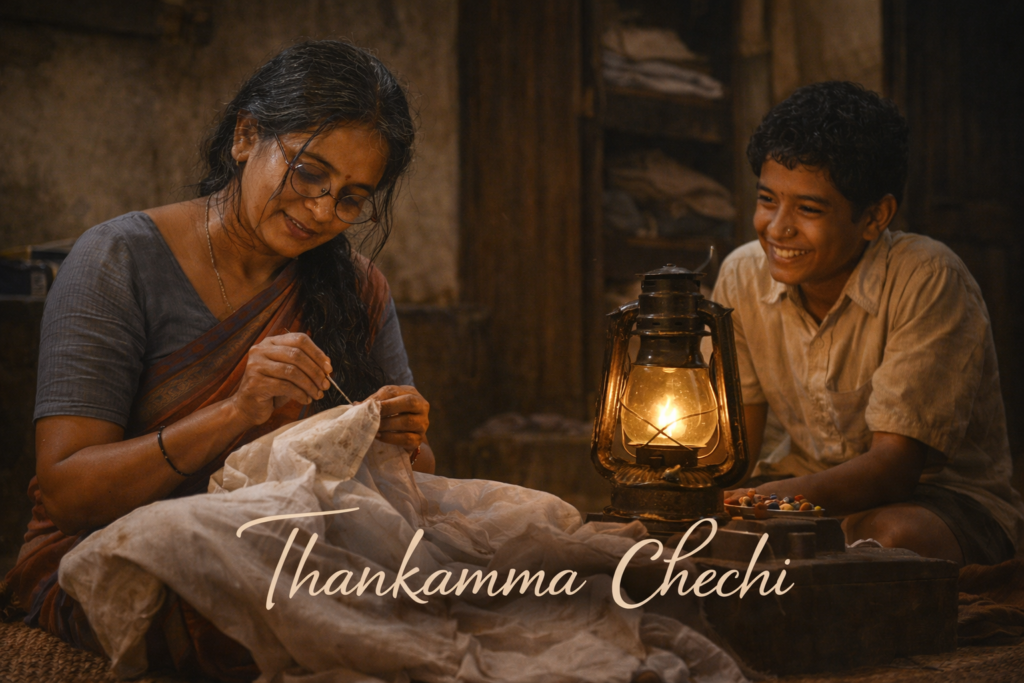
Thankamma Chechi
Certain memories refuse to fade, especially those from childhood days.
Years slip by. Faces grow distant. Houses crumble. Fields change their colours with the seasons. And yet, some moments remain, sharp and alive, like the scent of first rain rising from sun-burnt earth. They rest within us, quiet and watchful, patient and unyielding.
This memory comes from my childhood in a small village near Thrissur, where coconut palms leaned over narrow mud roads and paddy fields shimmered like green silk under the sun. Even now, after witnessing harsher truths and darker realities, I cannot pass a single day without remembering Thankamma Chechi.
I was thirteen, perhaps fourteen.
We lived in an old tharavadu (ancestral family house) with sloping red tiles and thick wooden pillars, polished by generations of hands. The long verandah stayed cool even in the May heat. Behind the house lay a cowshed, a lotus pond, and rows of coconut trees that whispered constantly to the wind. Not far away stood our village church, its once-white walls slowly surrendering to age.
First Saturday of every month, before the sun had properly risen, Thankamma Chechi would arrive.
She was a tailor who stitched and mended our clothes. I would hear Amma’s voice float from the kitchen:
“Thankamma Molé vannu.” ( Thankamma Mol Came)
She always walked straight to the upstairs room under the sloping roof, a room that smelled faintly of starch and dust. It was dim, slightly cold even in summer, and filled with folded clothes and old bedsheets.
Thankamma Chechi was tall and slender, with a quiet, natural beauty that drew attention without trying. Her skin glowed warmly in the sun, and her long hair, touched with a few silver strands, was always neatly braided. Her large, expressive eyes and soft smile gave her face a gentle radiance.
She walked with a slight lameness, a mild unevenness in her step, but it only made her movements slower and more graceful.
Watching her move was like watching a coconut tree bend against the wind: unstable, yet unbroken.
To me, she was beautiful.
On Saturdays, I would run upstairs the moment I woke. She would already be seated cross-legged on the mat, large round spectacles sliding down her nose, her needle flashing in quick, precise movements.
“Ente monu, ( my son) Come and sit near here,” she would say gently. “I shall tell you some stories.”
Her voice was rough, but it carried warmth like freshly brewed tea.
As she stitched, she told stories.
Not from books. Not from the cinema.
Stories of cows that wandered into toddy shops, hens that laid eggs in church towers, and village gossip that expanded into epics in her telling. In that dim room, under the slow creaking of the roof beams, her words felt grander than any legend.
Sometimes the smallest stories, told with love, grow larger than history itself.
Then came the Saturday that changed everything.
That afternoon, after helping Velappan Chettan collect fallen coconuts in the yard, I climbed upstairs to see her again. The house felt strangely quiet.
The sewing room door was half-open.
Her chair lay on its side.
She lay on the floor.
One hand still held the needle. In the other was my white school shirt, which she had been mending. Her spectacles had rolled near the wall. One leg stretched awkwardly beneath the chair.
“Chechi?” I whispered.
She did not move.
Something cold entered my chest, sharp and spreading.
I screamed. It was a shock for me.
Later, from the darkness of Appa’s large armchair where I hid, I heard Doctor Krishnan’s voice.
“It was her heart,” he said gently. “It stopped suddenly.”
Silence followed.
Then a sigh, heavy, almost reverent.
“Poor woman… Do you know she was once the prettiest girl in this village?”
Amma gasped. “Thankamma?”
“Yes. Seventeen. Slim like a coconut leaf. Hair down to her waist. When she walked to the well, boys invented reasons to stand nearby.”
I lifted my head.
The limping woman upstairs, pretty? The thought felt impossible.
“There was a new teacher then,” the doctor continued. “Rajeevan Master. Educated. Confident. Always dressed perfectly. The girls admired him. But he chose Thankamma.”
“Why her?” Appa asked quietly.
“Because she did not chase him,” the doctor replied. “She lowered her eyes and walked away. Silence attracts men who are used to applause.”
They began speaking after evening prayers under the banyan tree near the school.
“‘You stitch beautifully,’ he told her once.”
She smiled shyly. “It is my work, Master.”
“No,” he said softly. “It is talent.”
No one had spoken to her like that before. Her world had been narrow: housework, obedience, sewing. For the first time, someone made her feel visible.
When someone sees us fully, the heart begins to build dreams without asking for permission.
They met secretly in a storeroom above the school kitchen. One night, during the first heavy monsoon rain, she told her mother she was going to the temple, and went instead to him.
Rain pounded the tiled roof. Lightning flickered through a small wooden window.
He held her hand.
“Once I get a permanent posting,” he promised, “I will marry you.”
Whether he meant it or not, it no longer matters. She believed him.
Then came footsteps.
The headmaster.
The door flung open.
“What are you doing here?” the headmaster demanded.
Rajeevan panicked. He pushed her into the shadows.
“Hide,” he whispered fiercely. “If he sees you, my job is gone. My life is finished.”
Fear makes cowards forget love.
The headmaster locked the door and went to fetch a lantern.
Inside, rain roared like judgment.
There was only one escape: the window.
Second floor.
Stone courtyard below.
She opened it. Rain lashed her face. The wind howled.
“Are you mad?” he hissed, grabbing her arm.
“When he leaves, come and take me,” she whispered.
For a second, she looked back at him, perhaps hoping he would stop her.
He did not.
She climbed onto the ledge.
And she jumped.
The rain-slick stone caught her leg first. The crack echoed like a coconut splitting open.
When Doctor Krishnan reached her, she lay in the courtyard, blood mixing with rainwater.
“Did she scream?” Amma asked softly.
“No,” the doctor said. “She only said, ‘Don’t tell anyone about him.’”
Then, almost calmly:
“This is my punishment for loving too much.”
Some hearts blame themselves even when they are the only ones who were true.
The doctor told the village that a bullock cart had struck her. Rajeevan Master left within a month. He never returned.
She stitched clothes. She limped. She remained unmarried.
“She loved once,” the doctor finished. “For her, that was enough.”
That night, I heard the heavy steps on the staircase as they carried her body away.
Upstairs, her needle lay near the wall.
The woman children mocked.
The woman with the strange beard.
The woman who made cows and hens sound like legends.
She had once leapt into a monsoon night for love.
And the man she saved walked away untouched.
Love can lift a person toward the sky and, in a single frightened moment, drop them onto stone.
Even now, when rain strikes red tiles, or I hear the steady rhythm of a sewing machine, I remember her.
Some memories do not fade.
They remain, not to haunt us, but to remind us.
Not all heroes are celebrated. Some limp quietly through life, carrying their sacrifice like an unseen scar.