
A cold October night at Eeranpadi PHC
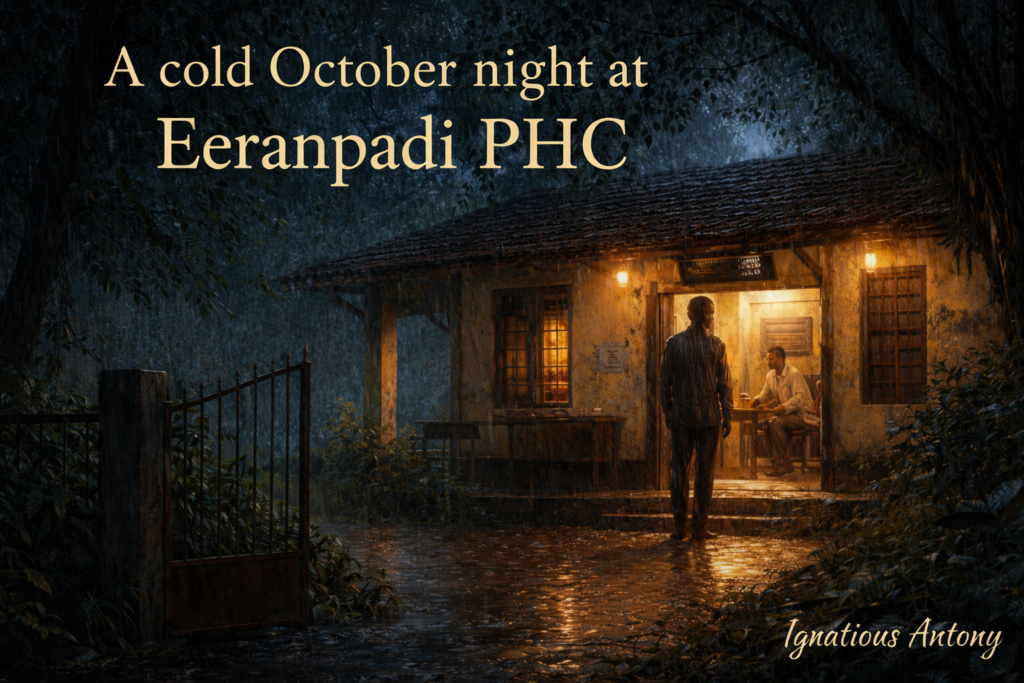
A Cold October Night at Eeranpadi PHC
It was a cold, rain-heavy night in October 1967, in Eeranpadi, a small village at the far edge of Thrissur district.
Behind a rusted iron gate and a row of tamarind trees stood the Government Primary Health Centre. The building was squat and weary, its yellow paint peeling, moss climbing the walls as if the monsoon had decided to stay.
Tube lights flickered like tired eyes refusing sleep. Inside, an old ceiling fan turned with a dull groan, and the wall clock struck nine.
Dong.
Dong.
Dong.
The PHC had closed an hour earlier. The day’s patients, children with fevers, farmers with aching joints, had all gone home.
Only two people remained.
Dr. Gopalakrishnan sat at his desk, slippers pushed aside, a folded newspaper resting in his hands. Across the room, Basheer, the compounder, boiled syringes over a small stove. He chewed betel and hummed an old film song, tapping its rhythm against a steel tray.
Institutions close by the clock, but suffering rarely follows rules.
The front door burst open.
A rush of cold wind swept in, carrying rain and red mud. A man stood in the doorway.
He looked as if he had been walking for days. His clothes clung to him, soaked and stained. A bruise darkened his forehead, and his eyes held the hollow stillness of someone who had not slept.
Basheer turned sharply.
“PHC is closed,” he said. “Come tomorrow.”
The man did not protest. He stepped inside and leaned against the wall, breathing hard.
“I don’t need medicine,” he said. “I just need to sit.”
Dr. Gopalakrishnan folded the newspaper and stood.
“You’re bleeding,” he said gently. “Come in.”
The man hesitated.
“I don’t have an OP Ticket,” he said. “Not even fifty paise with me.”
“That won’t matter,” the doctor replied.
He turned to Basheer.
“Clean the back room. Bring the first-aid box.”
Basheer frowned.
“Sir, he looks like a wanderer.”
The doctor’s voice hardened.
“Do it.”
Kindness, when delayed by judgment, often arrives too late.
They led the man to the old maternity room, long unused. A single bulb buzzed overhead. The air smelled of Dettol and damp cement.
As the doctor cleaned the wound, the man winced.
“They hit me,” he said quietly. “With sticks. Outside the school.”
Dr. Gopalakrishnan paused.
“I know you,” he said. “Narayanan Master. Government High School, Eeranpadi.”
The man lowered his head.
“I once heard you speak,” the doctor continued. “You spoke about dignity. About thinking before obeying.”
Narayanan Master’s shoulders sagged.
“There is no dignity left,” he said. “Only noise.”
The doctor pulled up a stool.
“My nephew studies there,” he said. “Yesterday he came home speaking of marches and slogans. My brother blamed books. Said I had ruined the boy.”
A tired smile crossed his face.
“I never imagined reading could frighten grown men.”
Basheer returned with tea and set the cups down noisily.
“Still hot,” he muttered.
Narayanan accepted a cup. His hands trembled.
“They were my students,” he said. “I taught them. And they dragged me out. Called me a traitor.”
“What did you do?” the doctor asked.
“I told them to stop,” Narayanan said. “Told them anger would only bring trouble. They said I sided with the powerful.”
He stared into the tea.
“When the police came, I signed a letter. Said I knew nothing.”
Fear has a way of borrowing our handwriting.
The room fell silent.
“That broke you,” the doctor said at last.
Narayanan nodded.
“I couldn’t go home. Even my son turned his face away. I’ve been walking since then.”
“You’ll stay tonight,” the doctor said.
He opened the medicine box.
“I’ll give you something for the fever. Basheer, bring soup from Kalyani’s shop.”
Basheer sighed.
“You think I’m your servant?”
“No,” the doctor replied. “Tonight, you’re simply needed.”
When Basheer left, the doctor applied balm to Narayanan’s shoulders, careful around the bruises.
“I don’t deserve this,” Narayanan whispered.
“Perhaps not,” the doctor said. “But wounds don’t ask who deserves care.”
Sometimes survival itself is the first quiet act of resistance.
Outside, the rain eased into silence.
Morning
Dawn arrived slowly, pale and unsure.
Narayanan Master stood before the cracked mirror. He tied his dhoti carefully; the cloth still damp from the night rain. His face looked clearer, not healed, but gathered. The bandage sat firm on his forehead.
Around his neck hung a small blackboard. Written in chalk were a few simple words:
I taught silence once.
Today I choose voice.
Teaching ends not when a lesson fails, but when the teacher stops listening.
Outside, the road filled, not with slogans, but with people. Young faces. Old hands. A waiting stillness.
Basheer leaned toward the window.
“Doctor… look.”
Narayanan stepped out.
He carried no flag. Only the blackboard.
His students noticed him first. Then others turned. Some lowered their eyes. Some stepped closer.
He did not shout.
He did not lead.
He simply stood.
There are moments when standing is louder than any speech.
From the PHC steps, Dr. Gopalakrishnan watched.
Basheer spoke softly.
“All that… for one bowl of soup?”
The doctor smiled.
“Sometimes that’s enough to remind a man he still matters.”
Behind them, the PHC door creaked open, ready for another day.
And sometimes, history changes not in streets or slogans,
but in small rooms, under weak lights,
where one human being chooses not to turn another away.