
I Carried My Girlhood in a Small Bag
I Carried My Girlhood in a Small Bag
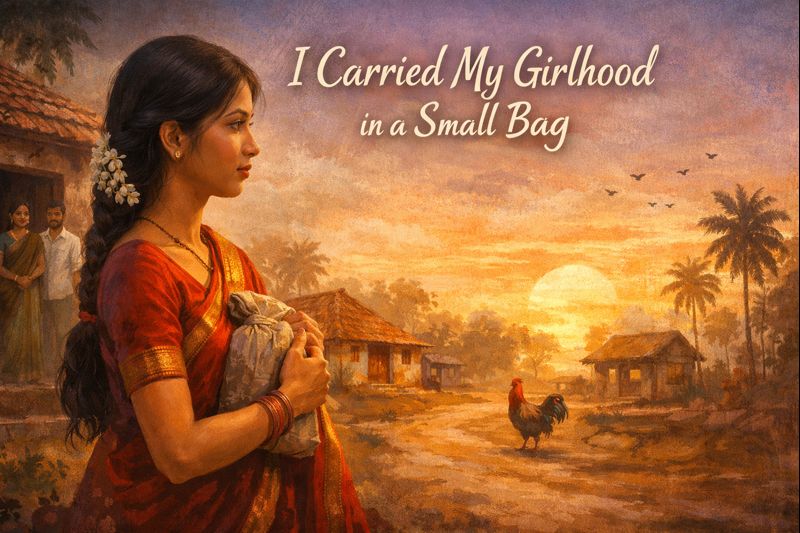
I carried my girlhood in a small bag,
pressed against my ribs
like a fragile bird learning my heartbeat,
as if it knew how afraid I was
to loosen my grip
and let it fly.
Before the sky opened its eyes,
when the rooster split the dark with his cry
and the house floated half-awake, half-asleep,
I lay beside him,
listening to silence stretch its limbs.
He slept peacefully,
as though the world had signed a promise
that nothing would ever move beneath his feet.
I watched his face
the way one studies a map before a long journey,
learning the lines of a life
I was about to enter,
wondering where, in all its roads,
I would find a place to rest my bones.
The moon stayed with me then,
pale as an unspoken thought,
hanging like a witness
who understood
that joy and fear
often lie down together,
sharing the same pillow,
breathing the same dark.
When morning came,
it did not knock.
It entered like fate,
unapologetic and bright.
I stood at the doorway of my room,
my feet rooted like stubborn stones,
my heart already walking away,
dragging its shadow behind it.
The walls had watched me grow,
they knew my tears
like rain stains on old plaster,
my laughter
like light slipping through cracked windows,
the sound of my name
spoken freely,
without explanation or effort.
My bed still smelled of me,
of jasmine crushed by sleep,
of warm nights and careless dreams,
of a daughter who never imagined
she would have to leave one love behind
to follow another into the unknown.
My mother’s voice
rose in my throat as I turned away;
it had lived inside me for years
like an inner lamp,
guiding, warning, blessing,
and without its glow,
the world suddenly roared,
too sharp, too vast.
My father did not say much;
he never needed to.
His silence stayed behind me
like a mountain holding up the sky,
heavy as earth,
strong as a promise
I could not carry in my hands,
only in my spine.
I walked out without looking back,
afraid that one glance
would shatter me into my former self,
afraid I would return
unfinished.
In this new house,
everything is careful.
The doors breathe differently.
The air pauses,
as if listening
before it decides to belong.
I smile more than I speak,
weigh my steps like coins,
and test every word in my palm
before letting it fall
into the room.
His family watches me kindly,
yet I feel like wet clay
set among vessels already fired,
hoping I will not crack
before the kiln of time
gives me a shape.
Love is here.
He holds me gently,
his touch steady as an anchor.
Yet love, too, is a language,
it asks learning:
his silences,
his people,
his ways of standing in the world
that are not yet mine.
At night, I lie beside him
and imagine the days ahead,
shared mornings unfolding like folded cloth,
unspoken expectations
resting between words,
small misunderstandings
that may bruise
like hidden stones under bare feet.
My heart feels like a bird
released into an enormous sky,
wings trembling with freedom,
eyes searching desperately
for a branch
that already knows my name.
I do not regret this life,
but I mourn the one
that ended without bells or witnesses,
slipping away
when I crossed a threshold
with a small bag
and a very large ache.
I am learning now
to be brave in love,
to carry longing
like a quiet flame,
to grow roots
in unfamiliar soil,
to trust that one day
this house, too,
will echo
with my heartbeat.
Until then,
I walk softly,
holding my parents
in every breath I take,
holding my future
like a fragile offering in my hands,
and hoping
there is room enough in me
for both.
Reflection on “I Carried My Girlhood in a Small Bag”
This poem is not only about marriage or leaving home. It is about a moment when a woman’s life tilts silently from one world to another.
The “small bag” in the poem is not important for what it carries on the outside, but for what it holds inside, memories, habits, voices, smells, and a way of being that cannot be packed neatly or replaced.
The opening image of holding girlhood close to the ribs tells us immediately that this is an intimate leaving.
The ribs protect the heart, and what is being protected here is not fear alone, but tenderness. The girlhood being carried is fragile, alive, and afraid of being loosened, much like the speaker herself.
It suggests that growing into a new life does not mean discarding the old one; it means carrying it carefully, knowing it can be bruised.
The early morning setting, before the sky opens its eyes, mirrors the speaker’s inner state. She is awake while the world sleeps, standing at the edge of change while others remain undisturbed.
The man beside her sleeps peacefully, already settled into the certainty of continuity. This contrast quietly shows how transition often weighs more heavily on those who must cross thresholds, not on those who remain where they are.
The poem treats the parental home with deep reverence. The walls, the bed, the smell of jasmine, the ease of hearing one’s name, these are not dramatic objects, yet they carry enormous emotional weight.
Home is shown as a place where identity was effortless, where love did not need explanation.
Leaving it is not loud or theatrical; it is quiet, almost ceremonial in its restraint.
The mother’s voice and the father’s silence represent two different kinds of inheritance.
The mother’s voice is internal, guiding and blessing, something the speaker must now learn to live without hearing aloud.
The father’s silence is grounding, heavy and steady, like earth itself. Together, they form the emotional spine the speaker carries into her new life.
In the new house, everything feels measured and watchful. The poem beautifully captures the vulnerability of being new, of learning when to speak, how to step, how to belong.
The simile of soft clay among finished vessels is especially powerful. It speaks of incompleteness without shame, of becoming rather than being. The speaker is not broken; she is still forming.
Love in this poem is real and present, but it is not romanticized. It is shown as something that also requires effort, patience, and translation.
Loving someone means learning their silences, their people, their unspoken rules. Love here is not just affection; it is adaptation.
One of the most striking images is the heart as a bird released into a wide sky. Freedom and fear exist together.
The sky is vast, full of possibility, but the bird still longs for a branch that recognizes it. This captures the deep human desire not just to fly, but to be known.
The poem ends without resolution, and that is its quiet strength. The speaker has not “arrived.” She is still learning, still walking softly, still holding past and future at once.
There is no rejection of the new life, only a gentle mourning of what was lost and a hopeful trust in what may grow.
“I Carried My Girlhood in a Small Bag” reminds us that some endings do not announce themselves. They happen at doorways, at dawn, with small bags and large aches.
And becoming brave, the poem suggests, is not about forgetting where we came from, but about making room in our hearts to carry both who we were and who we are becoming.