
The Road After Goodbye
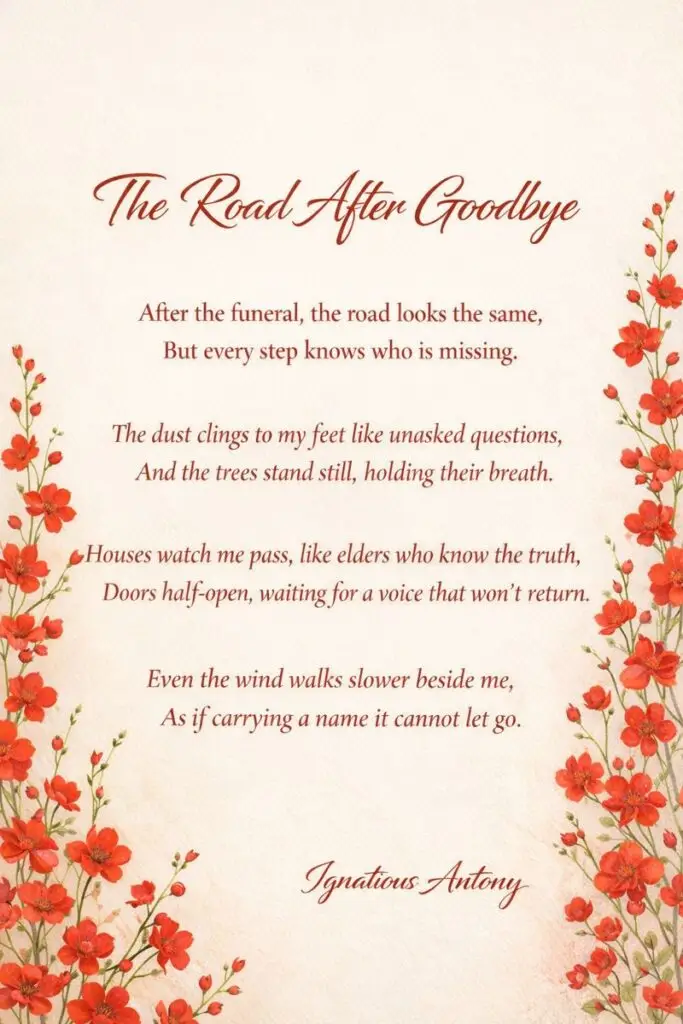
The Road After Goodbye
Reflections on the poem
After the funeral, when people have gone home and the rituals are over, the world looks unchanged, and the road remains exactly as it always was, yet the person walking on it is no longer the same.
Each step feels the absence of the one who is gone, as if the body itself remembers who should have been there.
The dust sticking to the feet feels like the many questions that rise in the heart but are never spoken aloud, questions about why this loss happened and how life is meant to continue.
The trees seem to stand still, as though even nature has paused in respect, holding its breath in the heavy silence that follows grief.
Houses along the way appear to watch quietly, like elders who have seen many such moments before and understand sorrow without needing words.
Half-open doors suggest old habits and fragile hope, waiting for a familiar voice that will never return, reminding us how loss settles into ordinary spaces of daily life.
Even the wind seems to move more slowly, walking alongside the mourner, carrying the memory of a name that refuses to fade.
The poem captures that lonely walk back into life, where everything looks the same, yet every moment is filled with the weight of absence, and love continues to exist in the quiet spaces left behind.
What the whole poem is really about
This poem is not about the funeral itself.
It is about the walk back to life, when life looks normal, but you are not normal anymore.
It shows grief as:
memory in the body (every step knows),
questions that stick (dust),
silence that feels alive (trees holding breath),
a world that watches quietly (houses like elders),
hope that has nowhere to go (half-open doors),
time moving slowly (wind walking slower),
love that refuses to loosen (a name it cannot let go).