
The Day Curiosity Learned to Whisper
The Day Curiosity Learned to Whisper
St. Martin’s Institute of Applied Science and Technology in Mumbai was known as a quiet, disciplined place. It was not flashy.
It did not appear often in newspapers. But among students and teachers, it had a reputation for seriousness and order. People believed that good work happened there, slowly and carefully.
The campus itself felt calm. Long corridors, old trees, and a chapel bell that rang softly in the evenings. Students came from many parts of India, carrying dreams that were bigger than their suitcases.
It was in this institute that I spent some important years of my life. And when I think back now, what I remember most clearly is not the success stories, but one long lesson that unfolded quietly.
At the centre of that memory stands Father Dr. John D’Souza.
Father John
Everyone called him Father John.
He was a priest, a senior professor, and one of the most respected scientists at the institute. He walked through the campus every morning at the same time.
His white cassock was always clean and well-pressed. His shoes shone. His files were neatly arranged, as if disorder itself made him uncomfortable.
In the early years, people admired him. He was known for his sharp mind and strict discipline. Students said that if you survived under Father John, you could survive anywhere.
There was also a gentle humour about him then. Once, when a lab assistant placed a stool in the wrong corner, Father John smiled and said,
“Even furniture must respect symmetry.”
We laughed.
And we trusted him.
The Glass Cabin
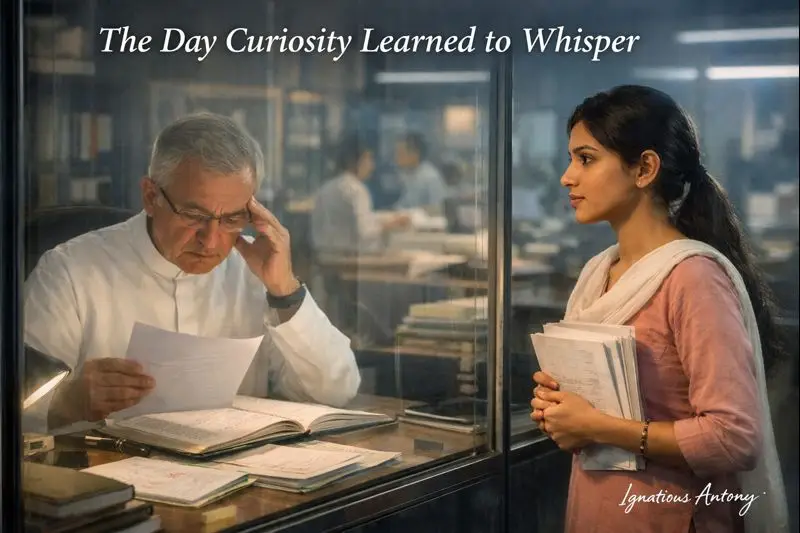
The main laboratory had a glass cabin at its centre. Father John worked from within it.
The idea was transparency. Anyone could see him inside, reading or writing.
On his table lay research journals, grant letters, reviewer comments, and a thick notebook filled with equations in his precise handwriting. A heavy pen rested on top, always placed carefully, never casually.
He read constantly.
But over time, something changed.
He no longer read with curiosity.
He read to judge.
Outside the cabin, research scholars worked quietly. Conversations fell silent when he stood up. Laughter stopped halfway. Ideas were discussed only after careful thought.
Before speaking, people first asked themselves whether Father John would approve.
Silence entered the lab slowly, without announcement.
How Discipline Changed Shape
Father John strongly believed in discipline. In the beginning, it helped everyone. Deadlines were met. Papers improved. Standards were high.
Then discipline slowly turned into control.
Weekly reviews became frequent inspections. Suggestions became firm instructions. Drafts returned sounding less like the student and more like Father John himself.
He never shouted.
He never openly insulted.
Instead, he used pauses.
A long look.
A sentence like “I expected better from you.”
That was enough.
We adjusted. We told ourselves this was how great institutions worked. Slowly, we learned that silence was easier than honesty.
A simple truth became visible, though no one said it aloud: fear and learning do not grow well together.
Meera
Meera joined the institute as a postgraduate in Physics. She had completed her Master’s degree with good results and came to St. Martin’s to pursue her PhD.
Father John was appointed as her research guide.
She was quiet, polite, and serious about her work. She spoke little in meetings. She listened carefully. She spent long hours in the lab. Her notebooks were neat. Her data was solid.
When she asked questions, they were thoughtful and respectful. She never tried to challenge authority. She was simply interested in understanding the truth behind the equations.
Father John initially seemed pleased with her discipline.
The Paper
One evening, Meera submitted a preprint as part of her doctoral work.
It showed that one important assumption – an assumption closely linked to Father John’s earlier work – was incomplete.
Not wrong.
Just incomplete.
It did not attack Father John’s research.
It did not make any dramatic claims.
Father John read it alone in the glass cabin.
He did not call a meeting.
He did not make any comment.
But from that day, something shifted in the lab.
How Fear Teaches Silence
Meera’s reviews began to take longer.
Then even longer.
She was asked to repeat experiments already validated, then asked to reframe the conclusions, and then told the timing was not right.
Her access to certain instruments was delayed. Funding priorities were changed. Her contract extension became “under discussion.”
Nothing was openly cruel. That made it harder.
We watched.
We saw Meera staying up late. We saw her reading emails again and again. We saw the tiredness in her eyes, not because her work was weak, but because she felt alone.
We felt uneasy.
But no one spoke.
Because fear teaches quietly.
It teaches you that speaking has a price.
And silence feels like safety.
When Truth Found Another Door
Truth has patience.
Another lab, unrelated to ours, reproduced Meera’s results. A conference abstract appeared online. Senior researchers began asking questions.
At first, the questions were polite.
Later, they became specific.
A committee was formed, not out of anger, but out of procedure.
Emails were read. Timelines compared, decisions placed side by side.
There was no single dramatic mistake.
Only a pattern.
Father John spoke calmly. He used familiar terms – academic rigour, quality control, and due process. He sounded reasonable.
But something had changed.
The words that once closed discussions now only filled the room.
They are no longer convinced.
The Last Day
On his final day, Father John sat alone in the glass cabin.
The journals were still there.
The pen lay exactly where it always had.
But outside, no one waited.
Once, that silence meant respect.
Now, it meant absence.
His work remained in textbooks and footnotes. That did not disappear. But among students, his name was spoken carefully, as if it were something once powerful that had burned too long.
He had wanted to protect science.
Somewhere along the way, protection became possession.
What Remained
Science does not punish people.
It simply moves on.
Like a river flowing around a stone.
Meera left the institute not long after. Years later, I heard she was doing well elsewhere, working quietly and confidently among people who listened.
And one thought stayed with me:
Knowledge grows where space is given, not where control is tightened.
A Reflection, Many Years Later
Many years have passed since those days, and time has softened my judgments. I no longer think of Father John only as someone who failed others, but also as someone who slowly lost his way while trying to hold on to what once made him valuable.
Power entered gently, without warning, and perhaps even he did not notice when guidance turned into control.
Time has taught me that brilliance needs humility the way a flame needs air; without it, even the brightest light begins to suffocate itself.
What remains with me now is not anger, but a quiet gratitude for the lesson: that authority must listen more than it speaks, that silence, chosen too often, shapes outcomes, and that learning survives only where fear is kept outside the door.
Note to the Reader
The name of the institute and the names of the people mentioned in this story are not real names. They are fictitious and used only to tell this story and reflection. The story is not meant to describe any specific individual or institution.